
I spent New Year in Catania almost by accident. I hadn’t even heard of the city before planning this trip. It wasn’t on my radar and definitely wasn’t what I pictured when I thought of New Year in Sicily.
I wanted somewhere with mild winter weather, cool but not cold, quiet but not dead. Catania delivered all of that, along with considerably more fireworks than I’d bargained for.
Known as La Città Nera (The Black City), much of Catania was rebuilt using dark lava stone following Mount Etna’s eruptions. The result is a gritty, dramatic-looking city that didn’t immediately charm me. It took about five minutes.
Day 1: A Rocky Arrival and Rooftop Views
I arrived in Catania by train from the hilltop town of Taormina, which had already left me a little spellbound. (Read about my one-night stay in Taormina here).
By then, I thought I’d mastered Sicily’s railway system. My heavy luggage begged to differ. Despite my attempts to pack light, a combination of poor restraint and enthusiastic early-trip shopping had already begun to take its toll.
The taxi ride into the city centre felt slightly ominous, not because of the driver, but because of the scenery. Catania didn’t exactly greet me with open arms. The roads were rough and the buildings felt imposing. Reaching my Airbnb involved walking through a back alley and entering through a huge, heavy door. When it slammed shut behind me, the echo thundered up three…flights…of…stairs.
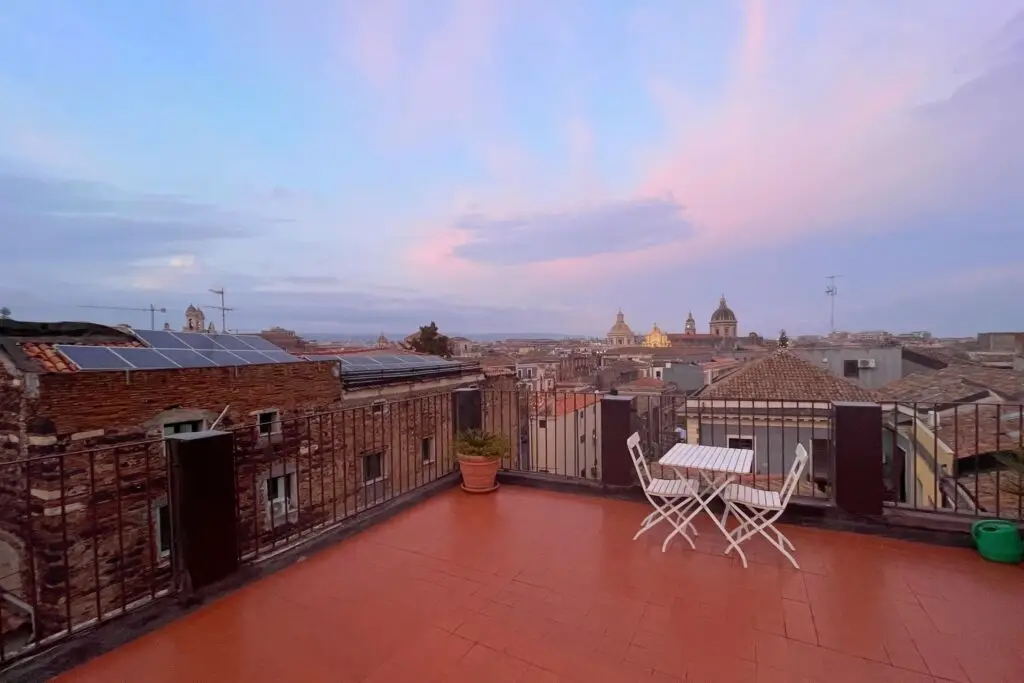
The apartment was a splurge for New Year’s week. It was stylish and compact, but the rooftop terrace was what had sold me. Except it wasn’t actually attached to the apartment. To reach it, I had to climb another narrow, dim staircase and wrestle with an ancient wooden door that looked as though nobody had opened it in several centuries. I half expected it to creak open into Narnia. Instead, it opened into something real. The terrace had sweeping views over Catania’s rooftops, with the Cathedral of Saint Agatha (Basilica Cattedrale di Sant’Agata) in sight and, on clear days, Mount Etna in the distance.
That evening, I went out for a short walk and something to eat. Within five minutes, the city began to soften. The Fish Market (La Pescheria) had already closed, but the surrounding streets were filled with locals out for their evening passeggiata, the slow, social stroll that Italians have turned into an art form.
It was the night before New Year’s Eve, and my first impression of Catania was already beginning to change.
Day 2: Mount Etna, Fireworks, and Honey Regrets
Early the next morning, I joined a group tour to Mount Etna. The drive up was bathed in sunshine, the volcano’s snowy peaks glowing like a giant powdered cannoli in the sky. By the time we reached the starting point for our hike, thick fog had rolled in and swallowed most of the view.
We still hiked across old lava fields and explored the strange, almost barren landscape. We also entered a lava cave wearing helmets and carrying torches. After all that build-up, the only living thing we found inside was one bat.
The tour ended at ORO d’Etna, a family-run producer of wine, olive oil, and honey. I sampled everything and bought two small jars of melon honey cream. I still regret not buying the large jar. It was one of the best things I tasted during the entire trip, and I haven’t been able to find anything similar since. (Anyone care to get me some?)
After returning to Catania, I stocked up on snacks and breakfast supplies in case everything closed for New Year’s Eve. I had no idea what kind of night I was preparing for.
By 9.30 p.m., fireworks had already started going off across the city. From my apartment, I could hear the concert taking place near the Duomo, while random bursts of light appeared above the surrounding rooftops.
At around 11.30 p.m., I headed up to the terrace with my 360 camera. I’d specifically booked the apartment because of its view towards the Cathedral of Saint Agatha, assuming there would be one grand fireworks display over the main square.
While I was trying to set up my equipment, I spotted a hand reaching out from the side of a nearby building holding what looked like a gun.
Bang! Bang! Bang!
Blanks, I hope. Let’s just say it added to the ambience.
While ducking from rogue overhead flares launched by the neighbours, I realised the real fireworks show wasn’t happening at the Duomo, it was exploding. All. Around. Me. It was beautiful, chaotic, and very, VERY loud.
By midnight, I was cowering behind a rooftop wall like a skittish cat while holding my phone in the air, filming without looking. Forget “photo of the year.” This was survival content. What I hadn’t expected was that the real action wouldn’t be in the distance. It would be exploding all around me like a cinematic war zone. The sky was ablaze in every direction. It wasn’t just a fireworks show, it was a full-blown sensory assault. A stunning, disorienting, very Sicilian cultural shock.
The fireworks didn’t end at midnight. They carried on, sporadically, like popcorn in a microwave until morning.
Day 3: San Berillo and My First Catania Pasta alla Norma
New Year’s Day was much quieter. Most of Catania had shut down, so I wandered into the San Berillo neighbourhood, a former red-light district that has gradually become known for its street art, creative spaces and small businesses tucked into narrow lanes.
I tried to eat at De Fiore Nuova Trattoria del Forestiero. It was closed. Thanks, Google, for once again proving unreliable when it comes to operating hours in Italy.
I eventually found a table at L’Oste Pazzo, located in what appeared to be a Nigerian neighborhood, there were a couple of Nigerian shops nearby, where I had a decent version of Catania’s beloved Pasta alla Norma.
Pasta alla Norma is one of Sicily’s best-known dishes and originated here in Catania. Made with pasta, tomato sauce, eggplant and ricotta salata, it would become a recurring dish throughout my stay as I tried different versions across Sicily.
The one at L’Oste Pazzo was decent, warm and comforting, which was exactly what I needed on a slow New Year’s Day.
After lunch, I continued walking, bought some baked goods from a kiosk whose name I can no longer remember and called it an early night. After the previous evening, I wasn’t in the mood for another late one.
Day 4: The Godfather Tour, Teatro Romano and the Best Pasta alla Norma
The next morning, I took the train back to Taormina for a tour I’d been looking forward to for months.
The Godfather Tour from Taormina was, without a doubt, a highlight. Our guide, the charismatic Marcello, delivered trivia with the flair of someone who could’ve easily played a consigliere if casting had gone his way. We were a small group, just myself and a lovely British couple, Dawn and Brett, meaning there were no crowds to block my movie reenactment fantasies.
Although the Corleone family took its name from the Sicilian town of Corleone, the village scenes in The Godfather were filmed in Savoca and Forza d’Agrò. Coppola chose these smaller hill towns because they better suited the period in which the story was set.
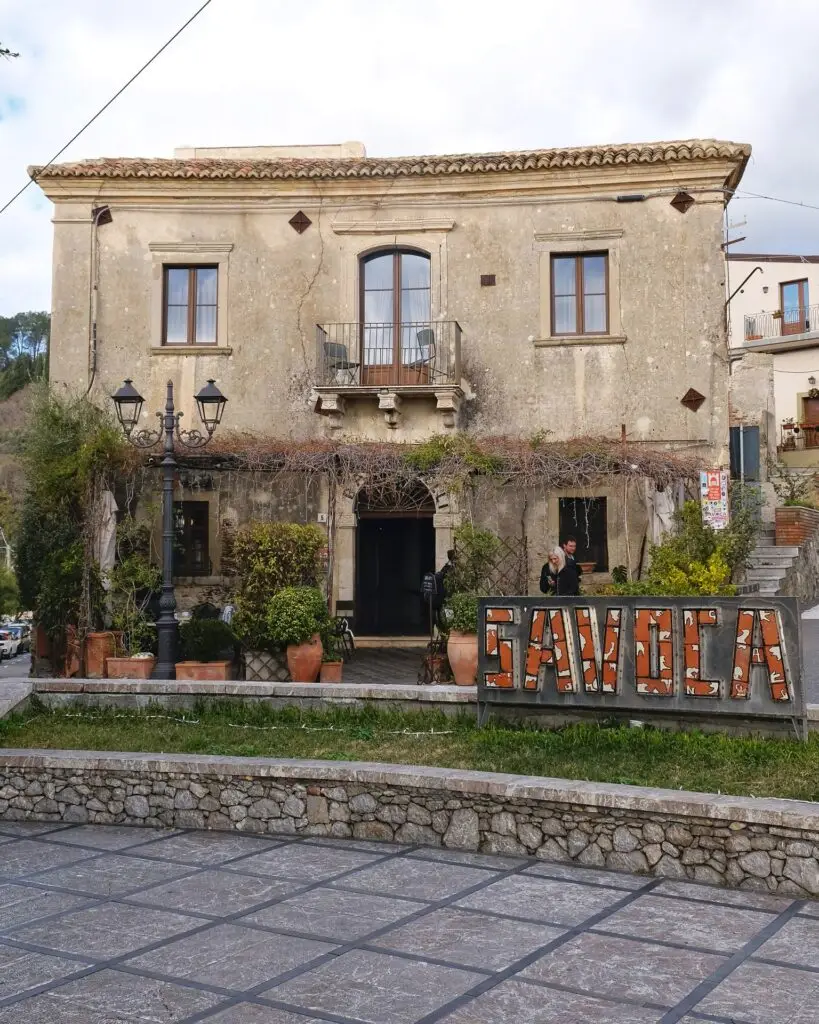
Savoca
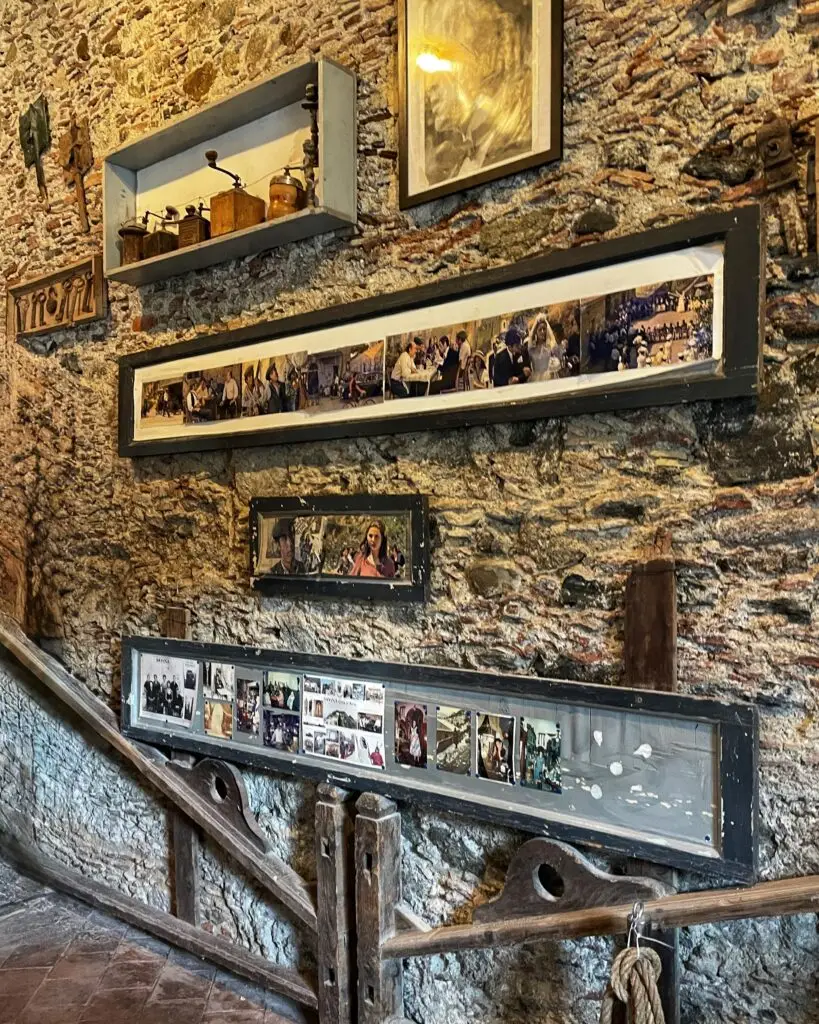
Savoca was our first stop. We walked uphill through its almost-empty streets to Bar Vitelli, where Michael Corleone meets Apollonia’s father in the film.
The bar had already been known locally for its lemon granita and biscuits before The Godfather made it famous. Inside, the walls were covered with photographs and memorabilia from the production.
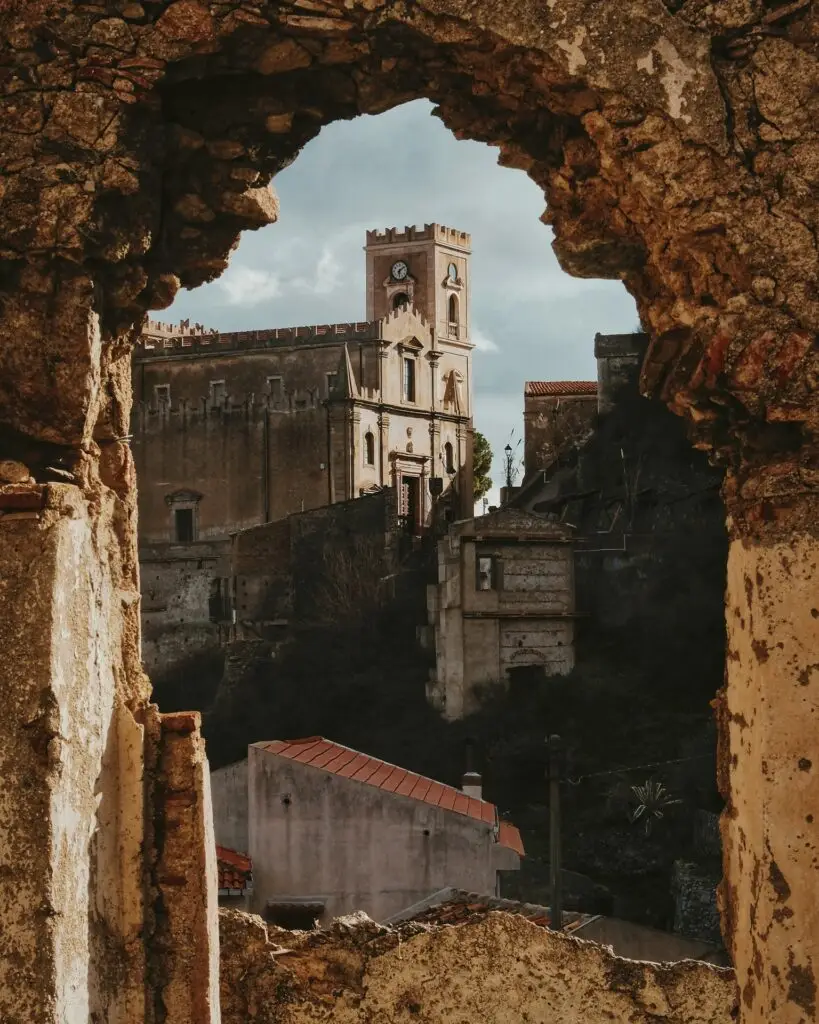
Cats dozed lazily in the bushes, the sun casting soft light through the vined pergolas that made the old stone walls glow. After looking around the bar, we continued uphill to Chiesa di San Nicolò (Church of Saint Nicholas), where Michael and Apollonia’s wedding scene was filmed.
The church itself wasn’t used in the film. The scenes took place outside, on the steps and along the road leading away from it.
Forza d’Agrò
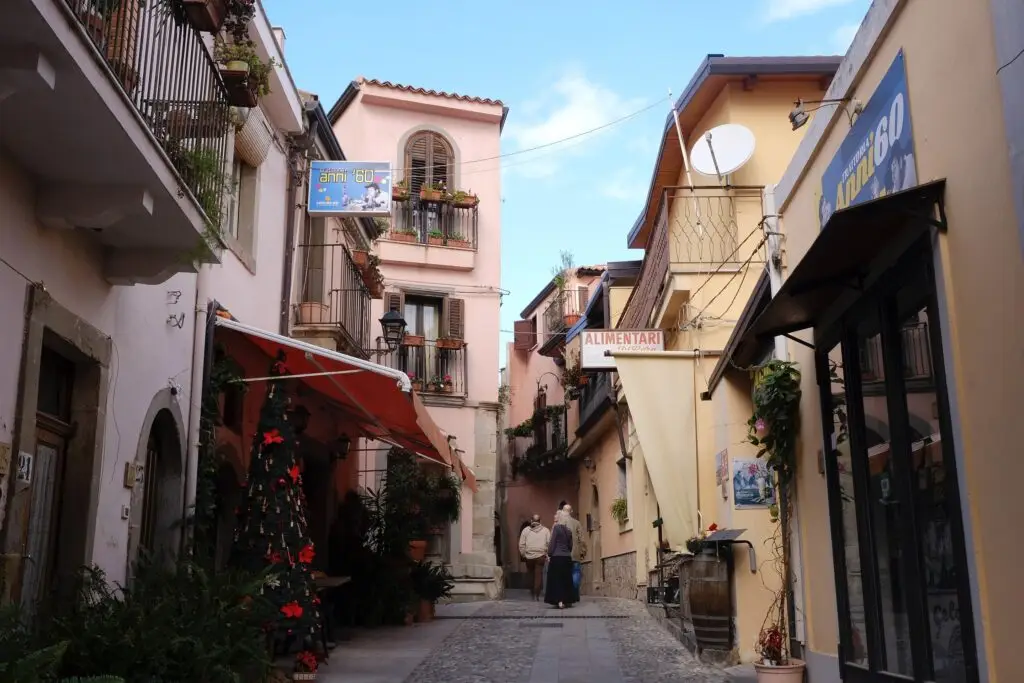
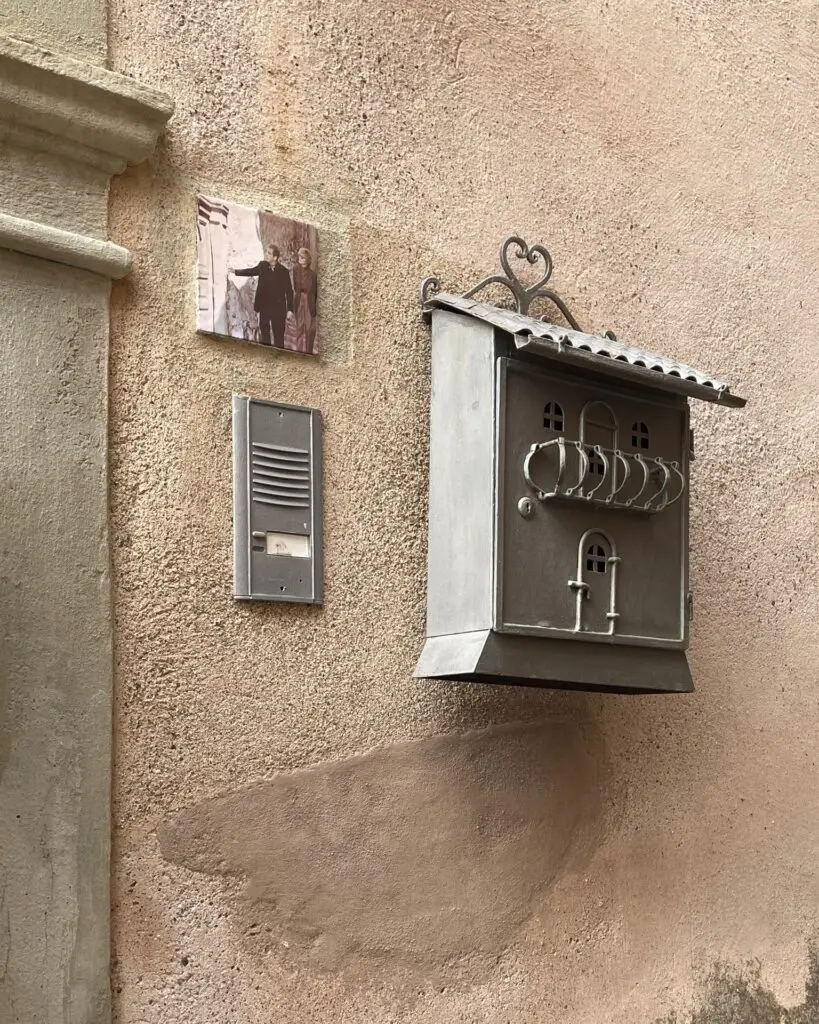
Just a 15-minute drive away, this authentic medieval village stood in for Corleone in the film. Marcello, true to form, promised us “the best view” at every stop. Each one somehow more breathtaking than the last. Its narrow cobblestone lanes and panoramic views made it an ideal filming location. With a population of only around 800, the streets were especially peaceful, adding to the dreamlike quiet. Honestly, I could get used to that high-altitude stillness.
It was photogenic, quiet, and felt like stepping into a time capsule or at the very least, the DVD extras of a Godfather box set.
Back in Catania, I made my second attempt at De Fiore Nuova Trattoria del Forestiero. Still closed.
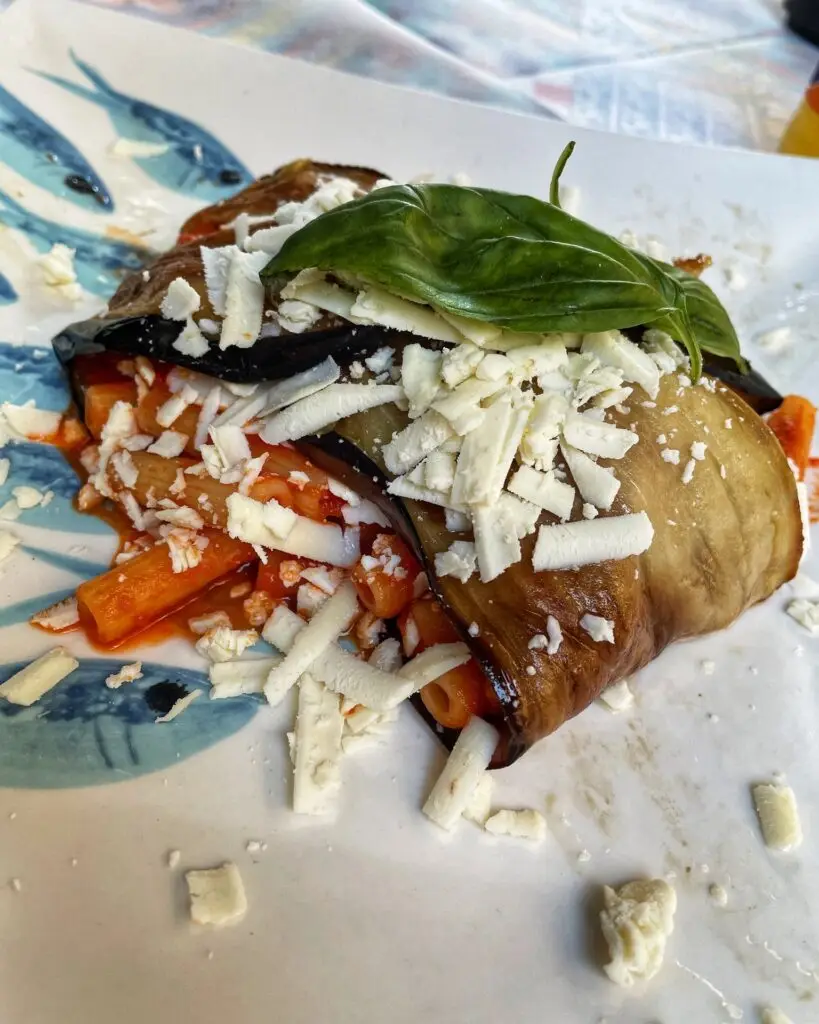
Hungry and undeterred, I wandered into Ciauru i Mari. That accidental change of plan led to the best pasta alla Norma of my entire trip.
The sauce was creamy and well-balanced, with the tomato, aubergine and ricotta salata working together without one overpowering the others. After eating several versions across Sicily, this remained my favourite.
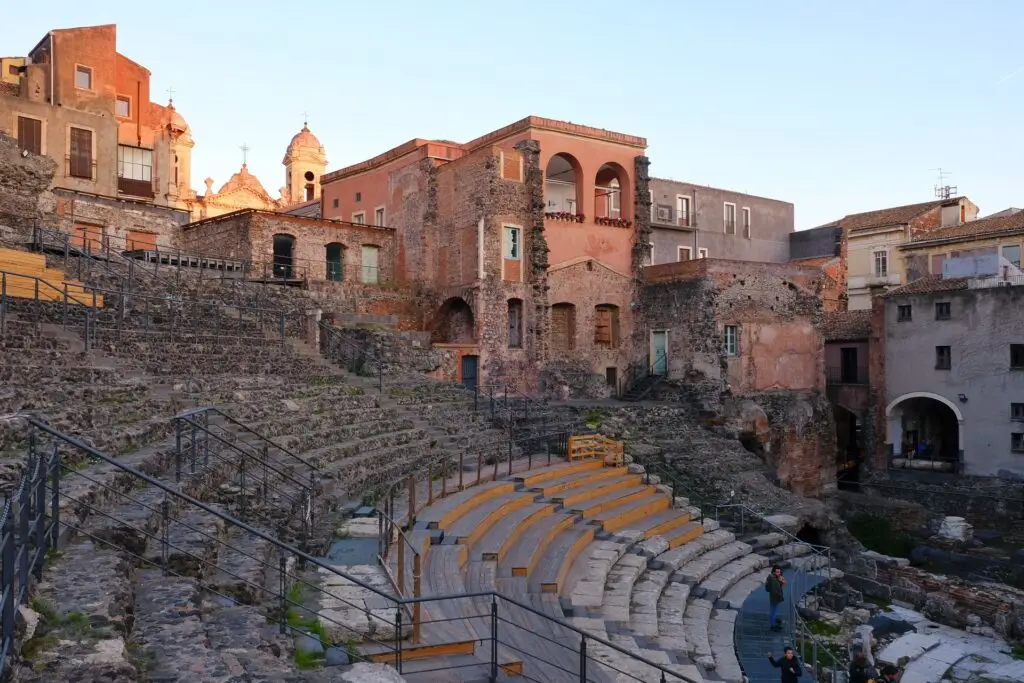
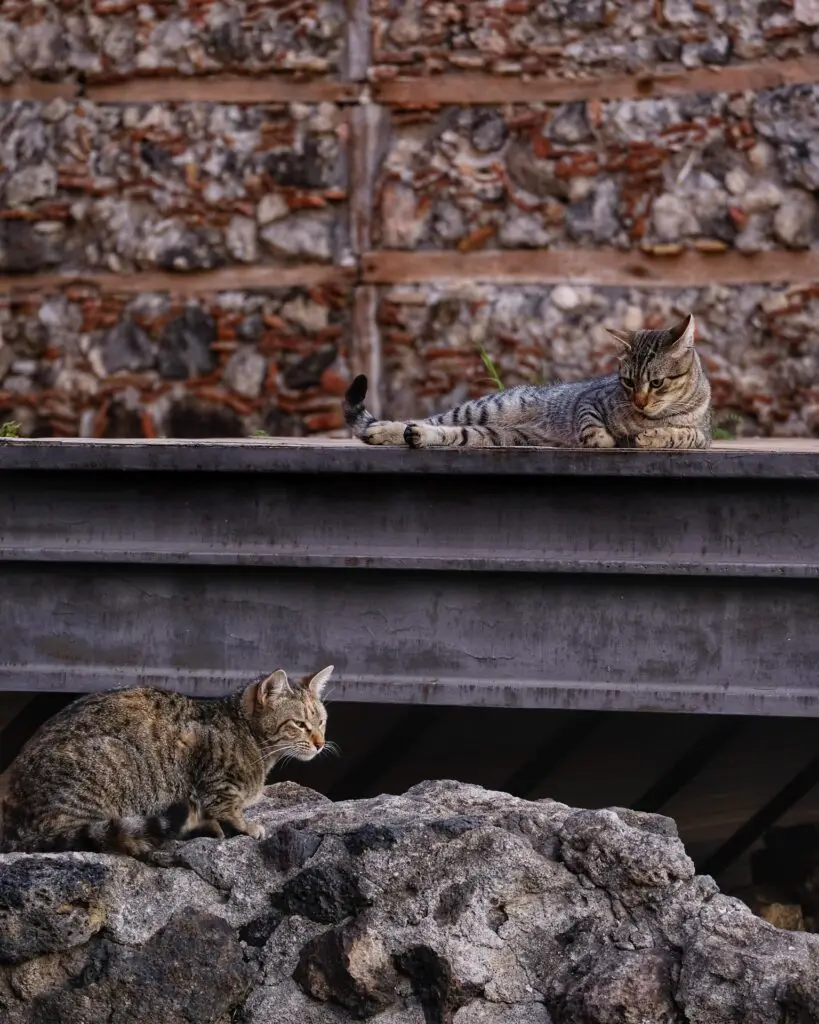
With some time to spare after lunch, I visited the Roman Theatre (Teatro Romano), an archaeological site I’d unknowingly walked past several times. From the street, it looked like another row of old buildings. Behind the façade was an ancient theatre built directly into the surrounding city.
The theatre dates mainly from the Roman imperial period and was designed to accommodate around 7,000 spectators. Modern buildings now press closely around the remains, which makes discovering it even stranger.
Cats lounged across the ruins while I wandered around the old stone seating. They appeared to have claimed the entire place for themselves.
Day 5: Ancient Ruins and Finally, Mamma Rosanna’s Kitchen
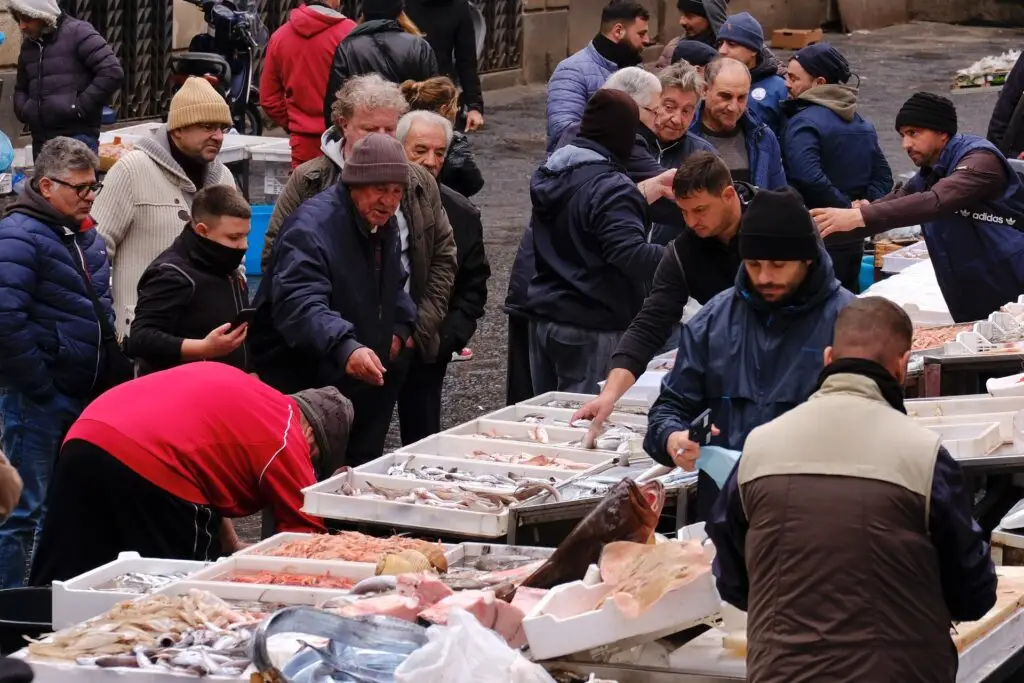
My final full day began with a quick visit to the Fish Market (La Pescheria), finally in full swing after the long holiday lull. Vendors were in full voice, and the place was alive with activity. I stayed just long enough to snap a few photos and soak in the vibrant energy before setting off to meet the day’s tour group.
Along the way, I made a new friend, a solo traveler from Australia, and we decided to explore the sites together.
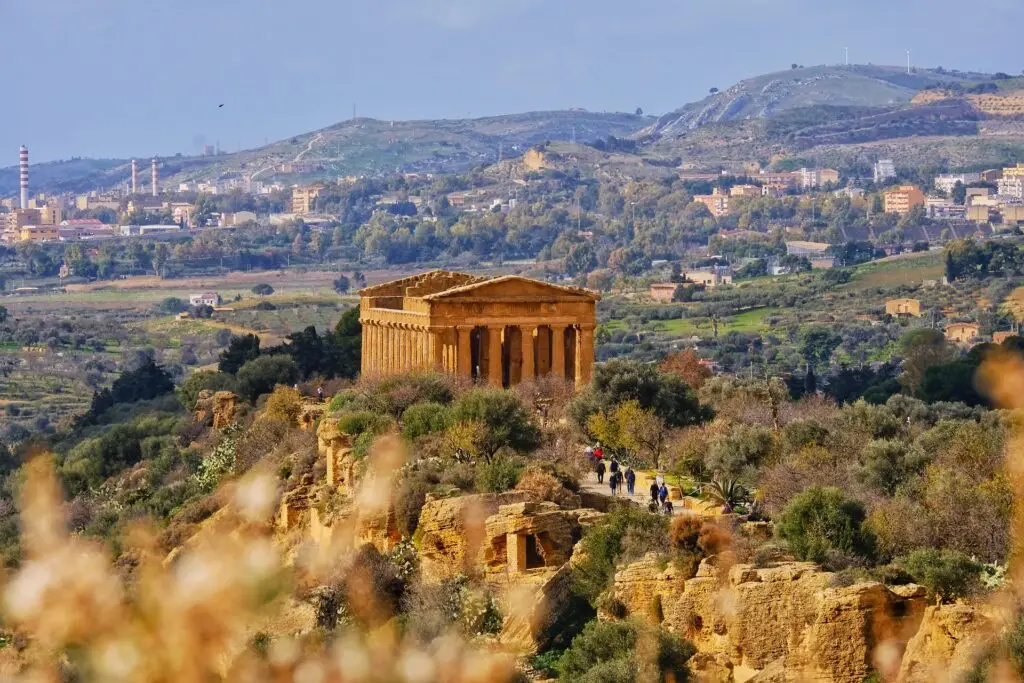
Our destination: the Valley of the Temples (Valle dei Templi), a UNESCO World Heritage Site filled with some of the best-preserved Greek temples in the world. Among them is the Temple of Concordia, an incredibly intact Doric temple dating back to the 5th century BC. Almost all its columns still stand, making it one of the most impressive ancient structures in all of Sicily.
Next stop: Villa Romana del Casale, famed for its vast collection of Roman mosaics, over 3,500 square meters of intricate storytelling through tile. Mythology, hunting scenes, domestic life, it’s all there, frozen in colourful detail.
That evening, finally, De Fiore Nuova Trattoria del Forestiero was open! It was still early by Italian standards, but I wasn’t taking any chances.
Founded in 1962, the trattoria is run by Mamma Rosanna and her son. Mamma Rosanna herself was right there in front of me, in the flesh, no less, though it was her son who served me that evening.
The Pasta alla Norma? It’s been voted the best in all of Catania. Classic and steeped in tradition. But for me, Ciauru i Mari still held the crown.
Day 6: Farewell, Catania
With a little more time on my hands, I made one last visit to the buzzing Fish Market (La Pescheria). In the crisp morning air, the absence of any “fishy smell” surprised me, likely thanks to the cold weather. Men hawked their catch with flair, and I stood on the sidelines and observed, camera in hand, soaking in the heartbeat of Catania one last time.
I’d arranged a late checkout, which took some of the pressure off getting ready for the next part of the trip. After one final look at the city, I collected my bags and said goodbye to the apartment, the rooftop and those three flights of stairs.
Final Thoughts
Catania took time to grow on me. My arrival felt slightly daunting, but within a few hours I was walking through busy streets, eating local food and looking out over the city from my rooftop terrace.
Spending New Year’s Eve crouched behind a wall while fireworks exploded above the neighbouring rooftops wasn’t quite the peaceful celebration I’d imagined. It was, however, one of the most memorable New Year’s Eves I’ve ever had.
I also left knowing I hadn’t seen everything. I never made it inside the Cathedral of Saint Agatha, and several places I’d bookmarked were closed for the holidays or simply didn’t fit into my itinerary.
I’d return to see more of the city, eat another plate of pasta alla Norma and, if possible, buy a much larger jar of melon honey.
Plan Your Own Trip to Catania
Here’s an overview to help you plan your own visit, particularly if you’re travelling during the Christmas and New Year period, when some businesses and attractions may operate on reduced hours.
Things to See in Catania
- Cathedral of Saint Agatha (Basilica Cattedrale di Sant’Agata): The grand heart of the city. I didn’t manage to go inside this trip, but it’s a must on my list for next time.
- Piazza Duomo & Elephant Fountain (Fontana dell’Elefante): The city’s central square and spiritual core. The lava-stone elephant statue known locally as u Liotru, is Catania’s quirky, symbolic mascot, perched beneath an Egyptian obelisk. Legend and mystery wrapped into one odd little monument.
- Roman Theatre (Teatro Romano):A compact archaeological site hidden in plain sight. Free to enter and perfect for quiet wandering among ancient stones and sleepy cats.
- Fish Market (La Pescheria): Arrive early to catch the energy of this lively market. No frills, just character, shouting vendors, and glistening fresh catch.
- Fera ‘O Luni: One of Catania’s oldest weekday markets located in Piazza Carlo Alberto. I missed it due to holiday closures, but it’s known for everything from produce to clothing and kitchenware.
- Well of Gammazita (Pozzo di Gammazita): Visible from the balcony of my Airbnb, this dark, eerie well is tied to a local legend of a young woman who chose death over dishonour. It’s easy to miss but fascinating to spot if you’re nearby.
- San Berillo District: If time allows, this former red-light area now features colorful murals, indie cafes, and a grittier creative vibe. Worth exploring for those interested in street art and urban regeneration.
Day Trips from Catania
- Mount Etna: Sicily’s iconic volcano. Book a guided tour to explore lava fields, hike craters, and visit honey and wine producers. I did this tour with Get Your Guide and highly recommend it.
- Savoca and Forza d’Agrò: These hill towns were used as filming locations for The Godfather. I took the train to Taormina and joined my tour from there. Depending on the operator, tours may also be available from Catania. I did this tour from Catania.
- Valley of the Temples (Valle dei Templi) & Villa Romana del Casale: Also referred to as Piazza Armerina. You can book this tour online, but I secured mine in person at the Tourist Service box office next to the Cathedral of Saint Agatha. These tours provide driver service only and you cover your own entry fees. A stress-free way to avoid multiple transfers or getting lost.
- Taormina: Around 45 minutes to an hour from Catania by regional train. Visit for the Ancient Theatre, sea views, public gardens and granita with brioche.
- Siracusa and Ortigia: An easy train journey south of Catania. Ortigia is Siracusa’s historic island centre and became one of my favourite places in Sicily.
Where to Eat in Catania
- Ciauru i Mari: My favourite pasta alla Norma of the trip. It was creamy, flavourful and well-balanced. The restaurant also specialises in seafood. Location map
- De Fiore Nuova Trattoria del Forestiero: A long-running trattoria operated by Mamma Rosanna and her son. It’s known for traditional Sicilian cooking and its pasta alla Norma. Check its current opening hours rather than relying entirely on Google, particularly during the holidays. Location map
- L’Oste Pazzo: One of the few restaurants I found open on New Year’s Day. It was a casual, welcoming place for my first plate of pasta alla Norma in Catania.
- Street food around Via Gisira: The streets surrounding the Fish Market have kiosks and casual food shops selling arancini, baked goods and other Sicilian snacks. Location map
Shop
- Via Etnea: The city’s main commercial street. You’ll find everything from high-street fashion to souvenir stalls and even luxury labels. Perfect for casual strolling and people-watching.
- ORO d’Etna: If you’re joining a Mount Etna tour, this is usually one of the tasting stops. Otherwise, visit independently to buy honey, olive oil, and wine. I still regret not getting the big jar of melon honey. Location map
- Vetriamo: A small stained glass shop I stumbled across, closed for the holidays, but the beautiful items I spotted through the window were enough to warrant a return.
Stay
- Centro Storico (Historic Centre): Ideal for first-timers. Walking distance to most landmarks, lots of charm (and stairs), and lively piazzas.
- Via Etnea area:A bit more polished, with easy access to shops, public transport, and cafes. Quieter in the evenings.
- Fish Market / Duomo area: Atmospheric and central, though more active and sometimes noisy. Best for foodies and photographers.
- Rooftop Airbnb near the Duomo: I stayed here for the fireworks views. Very close to the Fish Market/Duomo area. The terrace overlooked the Well of Gammazita and gave me one of the most memorable New Year’s experiences of the trip.
Getting Around Catania
- Walking: Much of central Catania can be explored on foot, although the lava-stone pavements are uneven in places. Wear comfortable shoes.
- Trains: Catania Centrale has direct regional connections to Taormina-Giardini, Siracusa and other destinations in eastern Sicily. Longer journeys may require changes, so check the route before booking.
- Buses and metro: Local buses and Catania’s metro connect the centre with other parts of the city. Services may be reduced on Sundays and public holidays.
- Tours: Guided or driver-only excursions are useful for Mount Etna, the Godfather villages, the Valley of the Temples and Villa Romana del Casale, particularly if you don’t drive.
- Airport transport: Catania Fontanarossa Airport is connected to the city by bus, and trains serve the nearby Catania Aeroporto Fontanarossa station. Check the latest schedule before travelling.
Keep Exploring Sicily
If you enjoyed this story, you might also like:
- Taormina in Winter: A Solo Traveler’s Peaceful Escape
- Why I Fell in Love with Ortigia, Sicily – A Solo Travel Guide & Story
- Winter in Palermo – A Travel Story of Rain and Resilience
Along the way, I squeezed in unforgettable side trips to places like Savoca, Ragusa, Modica, Cefalù, and Noto. Each one added a different color to the Sicilian palette.