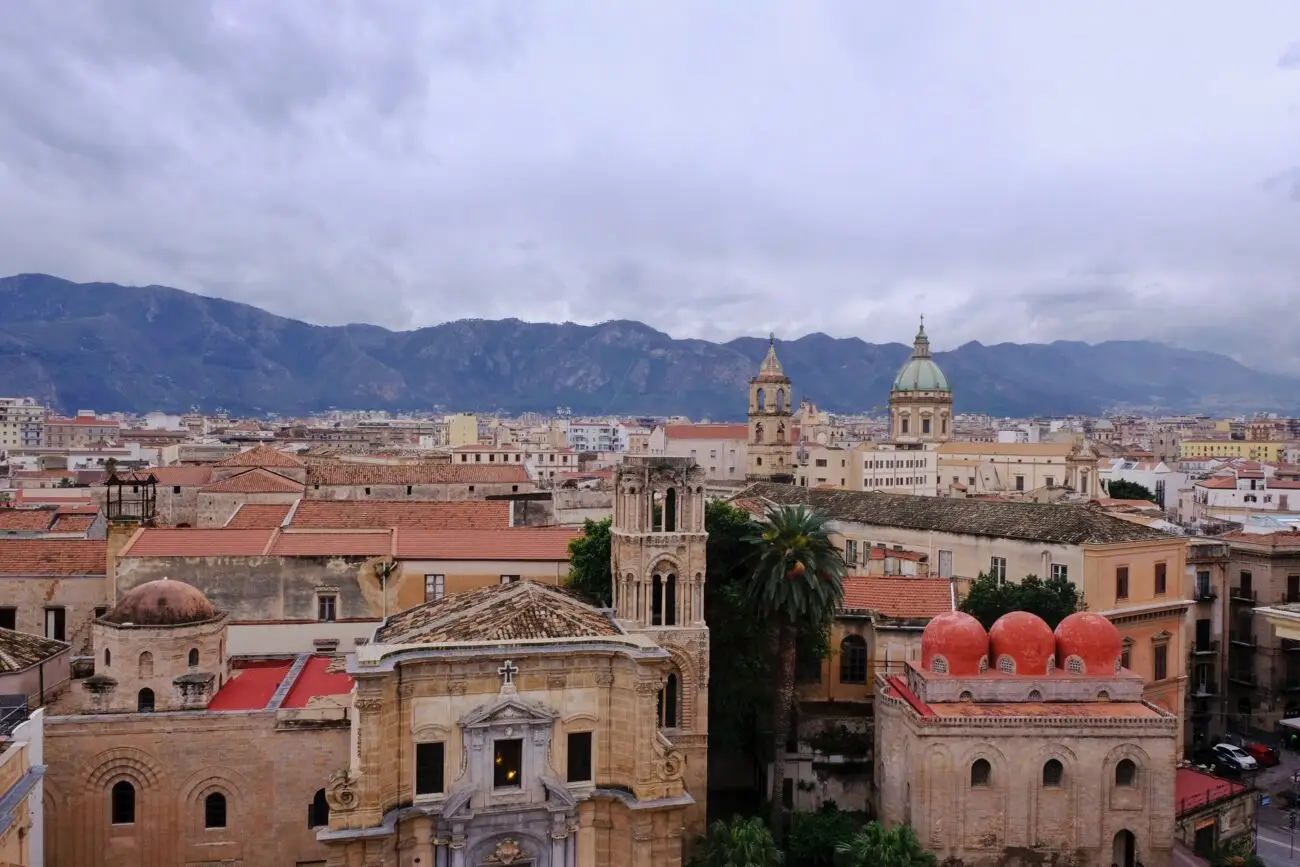
Palermo was the final stop of my two-week Sicily trip. By the time I arrived, I thought I had already experienced the best of the island, but Palermo turned out to be completely different from the cities that came before it.
Over four mostly rainy days, I wandered through churches, markets and neighbourhoods that sometimes reminded me of home. I also took a day trip to Cefalù, cried inside the Palatine Chapel, bought more art for walls I do not yet have, and ended the trip with an unexpected farewell from the sky.
Palermo is gritty, chaotic and full of contradictions. It does not try very hard to impress you, but parts of it certainly impressed me.
Day 1: Arrival in Palermo, Rain and Sicilian Stairs
I boarded the bus to Palermo with a little bit of dread. Not because I expected the worst, but because it marked the final leg of my Sicily trip, and part of me was not ready for it to end.
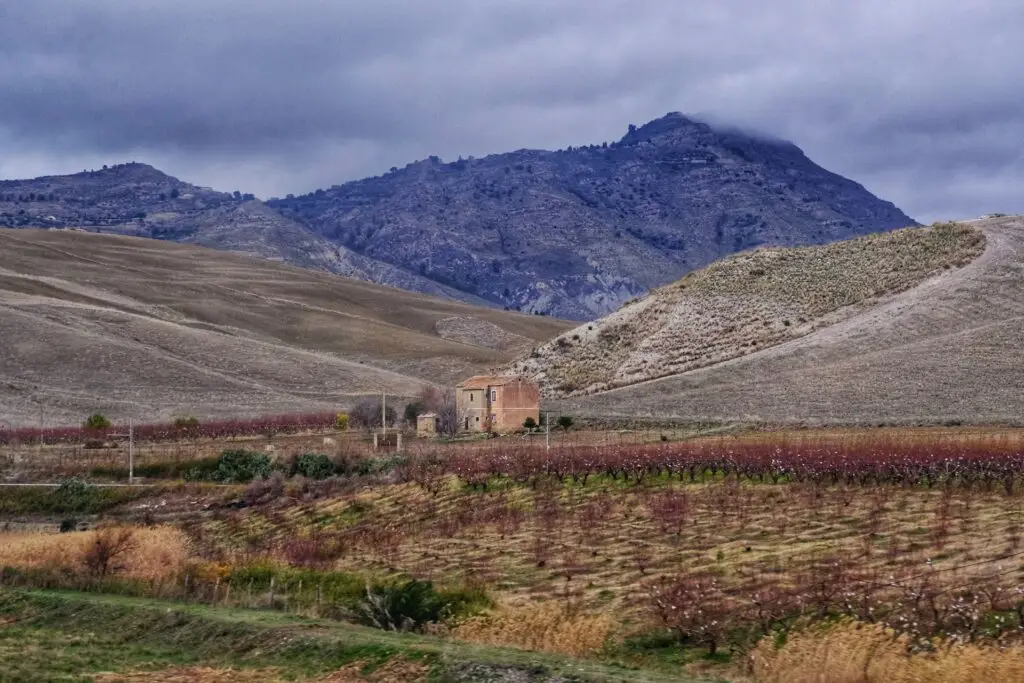
The ride from Ortigia was beautiful, even in the dreary winter rain. I watched the landscape change outside my window, already missing the slower pace of the island I had just left. You can read about my time in Ortigia here.
I arrived at Palermo Centrale beneath grey skies. My Airbnb was about ten minutes away along Via Roma, which should have been an easy walk. What awaited me at the end was another round of Sicilian stairs, except this one took the cake. They were narrow and steep, and the final flight had no handrail. Getting my suitcase all the way up was not how I wanted to begin my stay.
This time, I had booked a room in someone’s home rather than an entire apartment. The home came with an eager dog who greeted me like an old friend, which made up for the stairs.
I intended to take a quick 20-minute nap but woke up two hours later. Luckily, the night was still young. The rain had not stopped, but I went out for a short walk to get my bearings. The streets were wet and quiet, with strings of Christmas lights still hanging overhead.
What caught my attention was the familiar smell of coriander and cumin. The surrounding streets were lined with grocers, Indian restaurants and souvenir shops run by Bangladeshis. It reminded me so much of Little India in Singapore that I stopped walking for a moment.
I had read that La Kalsa could be gritty, rough around the edges and a little sketchy, but it did not feel threatening that evening. Perhaps it was because it was still early, or because I walked with purpose while following Google Maps. Mostly, something about the area felt unexpectedly familiar.
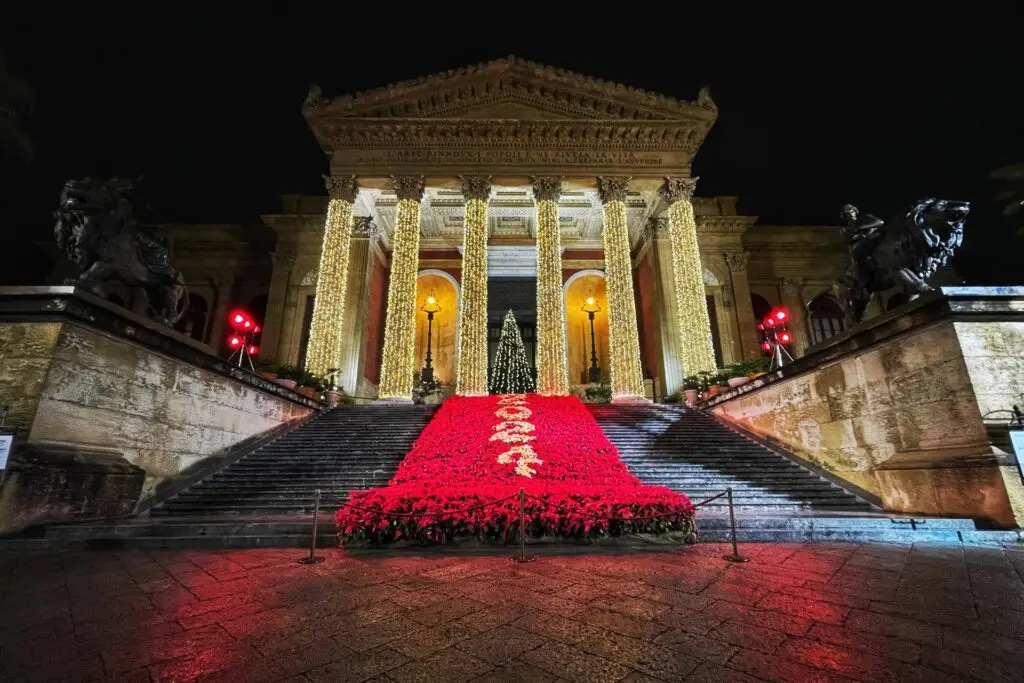
I eventually followed the flow of people to Teatro Massimo, Italy’s largest opera house. Fans of The Godfather will recognise it as the location where Mary Corleone is shot on the steps, followed by that dramatic slow-motion collapse and her father’s gut-wrenching scream.
What I found looked rather different. Christmas lights were wrapped around the columns, a tree stood at the top of the staircase, and red poinsettias ran down the middle of the steps. The drama was still there, but it was less mafia and more mistletoe-ho-ho.
I stood there for a while with rain speckling my glasses. It was not quite the first evening I had pictured, but Palermo was already more interesting than I had expected.
Day 2: Markets, Churches, and My Architecture Fangirl Moment
The rain had not stopped the following morning, but I was centrally located and determined not to let it dictate the entire day. Armed with an umbrella, I headed to Ballarò Market.
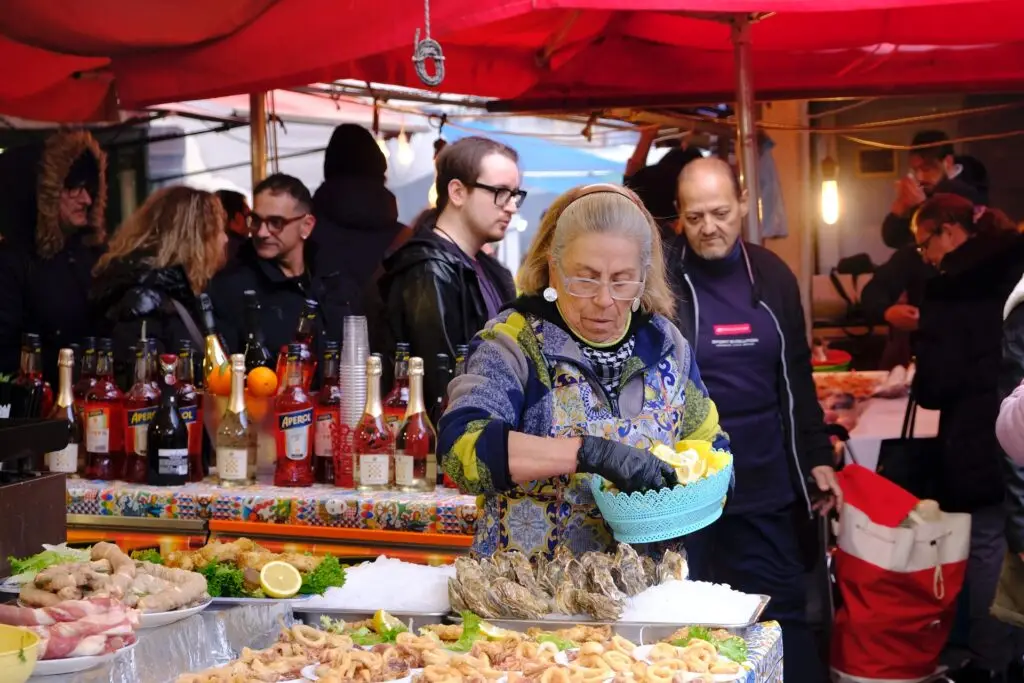
If Ortigia was orderly and calm, Ballarò was its chaotic, smoke-filled cousin. You enter through what looks like an ordinary alley, and suddenly it opens into a busy market beneath flapping tarps. Vendors shout, food sizzles and the wet cobblestones smell of citrus, frying oil and charcoal smoke.
I passed stalls piled with fresh produce, wheels of cheese and trays of arancine in various shapes. Ballarò is not curated or sanitised for visitors. It is noisy, messy and very much alive, and I loved it.
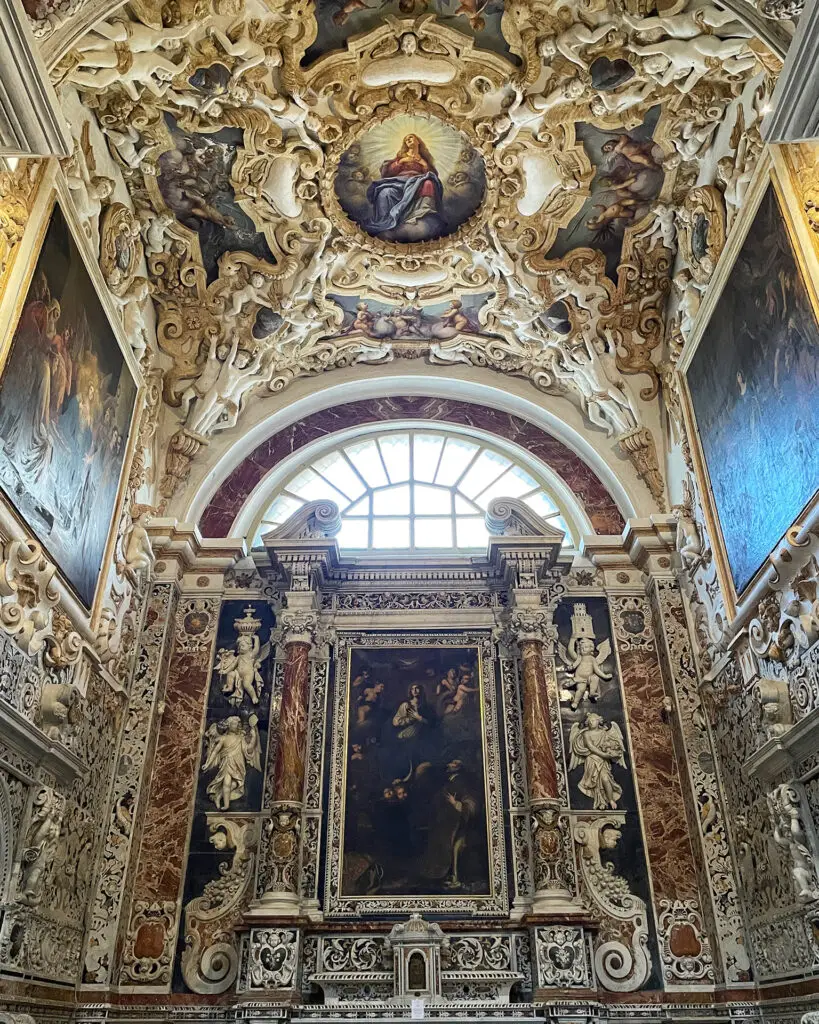
I eventually tore myself away from the food and began an unofficial church-hopping circuit, starting with Chiesa del Gesù (Casa Professa). This was Baroque at full volume. In art school, I used to dismiss Baroque as too ornamental. Casa Professa made me reconsider that opinion. Almost every surface was covered in coloured marble, gold, carvings and cherubs. It was excessive, but in this case, the excess worked.
A few streets away, I entered the Chiesa del Santissimo Salvatore (Church of the Most Holy Saviour). Originally built in the 11th century and later transformed in the Baroque style, it is known for its unusual elliptical interior and central dome.
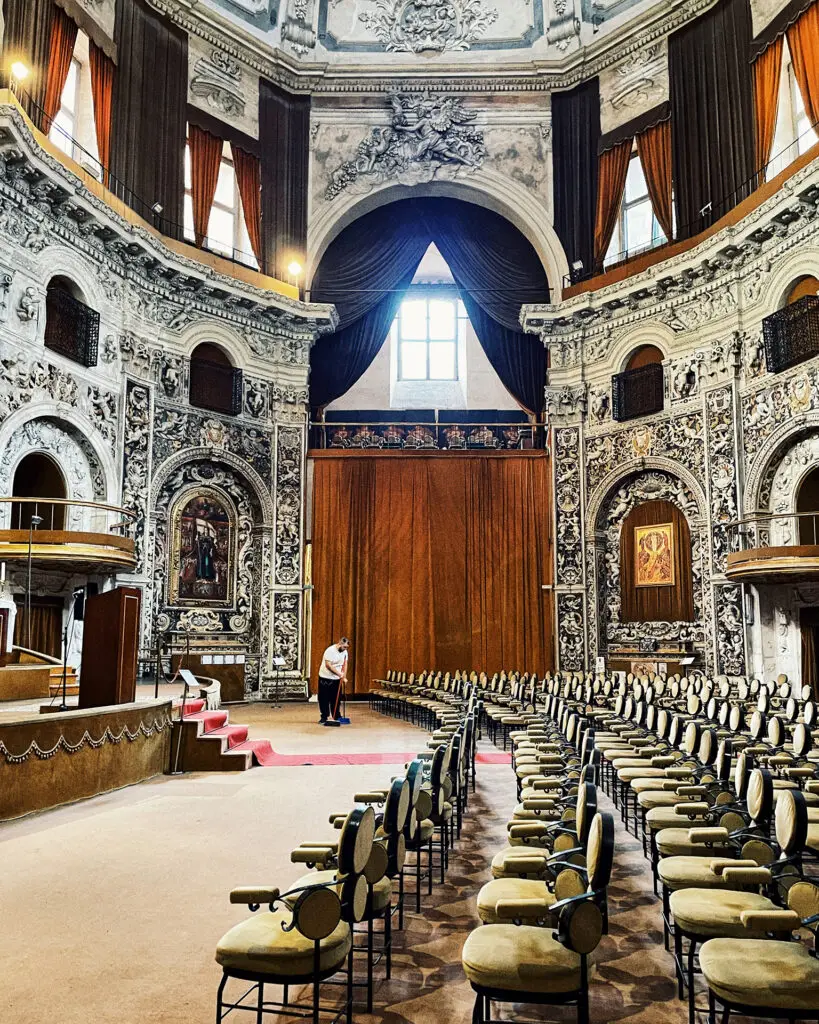
The dome was closed to visitors that day because of the rain, but I had almost the entire church to myself apart from a janitor quietly sweeping in one corner, making the whole scene feel like something from a Michel Gondry film.
The church was once part of a much larger complex, part of which was damaged during the Second World War and later converted into an auditorium. Standing there, I found myself imagining a younger version of me with a microphone in hand, preparing to play a show in a place like this.
The light coming through the arches picked out the black-and-gold details around the church. It was less ornate than Casa Professa, but I found the emptiness and atmosphere more affecting.
The rain eased slightly as I made my way to Cattedrale di Palermo (Palermo Cathedral). If you have ever searched for photographs of Palermo, you have probably seen its honey-coloured stone, palm trees and strange combination of Arab, Norman, Gothic and Baroque architecture.
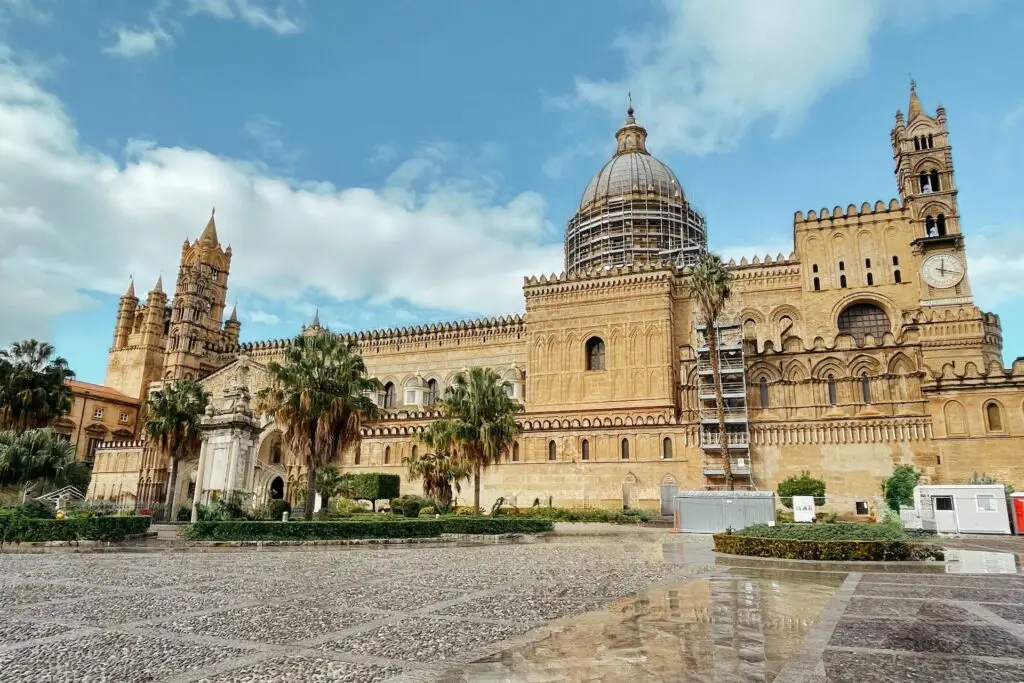
It was beautiful but packed. Tour groups surrounded the cathedral, and the constant movement of selfie sticks and people posing for photographs made it difficult to take everything in. I skipped the royal tombs and walked through the main hall, but I spent more time outside studying its jumble of domes, towers and arches.
Next was the Palazzo dei Normanni (Norman Palace). I went in without many expectations and was immediately distracted by the building itself. I barely looked at the temporary exhibition, for which I apologise to the curator, because I was far more interested in the arches and vaulted ceilings. My inner architecture fangirl had been activated.
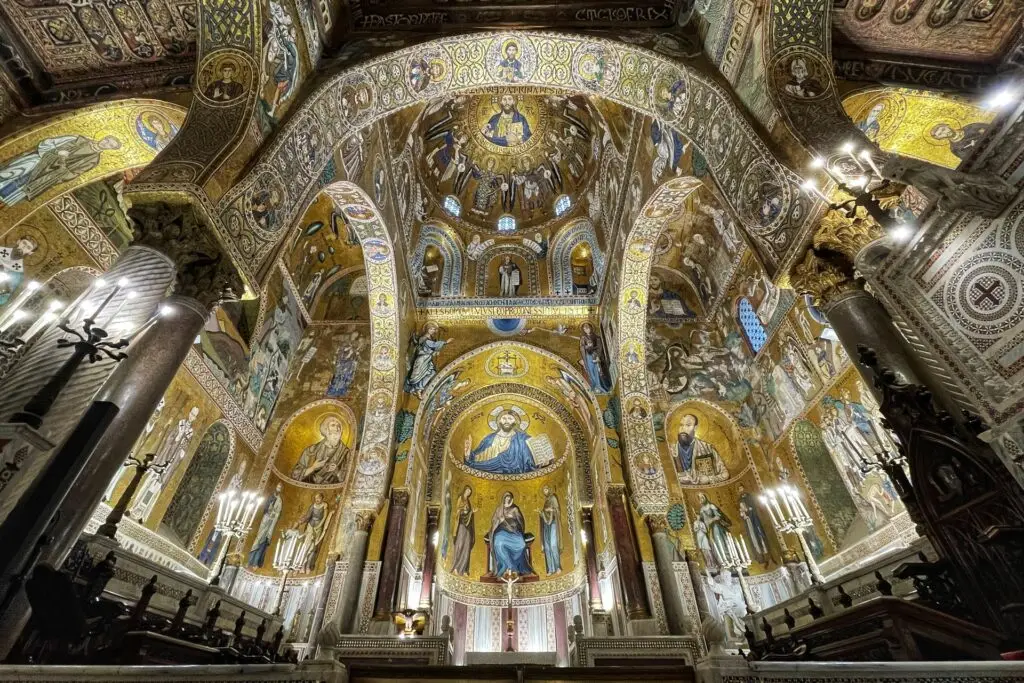
And then came the Cappella Palatina (Palatine Chapel). It is small, but absolutely breathtaking. I walked in and stopped. Gold, gold, gold. Almost every surface shimmered with Byzantine mosaics that seemed to flicker as the light hit them. It took eight years to complete, with millions of tiny mosaic tiles painstakingly placed by hand. Above it all was an elaborately carved muqarnas-style wooden ceiling unlike anything I had ever seen.
The chapel genuinely took my breath away. I didn’t speak. I didn’t want to. I just stood there with my head tilted back, my neck straining as I stared upwards with my eyes wide, trying to take it all in. At one point, I wiped my glasses and realised it wasn’t just the rain. My eyes had welled up. I was so moved by the beauty of the space that I’d actually started to cry.
I must have spent close to an hour inside, photographing every corner and completely losing track of time. When I finally emerged, I bought a souvenir gold coin from the vending machine outside. It was a little cheesy, but I needed something to remember that moment by.
My next stop was Chiesa di San Giovanni degli Eremiti (Church of St. John of the Hermits). It is better known for its architecture than its interior. The red domes were striking, and its courtyard filled with orange trees was peaceful, but there was not much else to linger over. It did, however, have the exact look of somewhere people would stage a flying-dress photoshoot. You know the type.
I then set out to find a present for my dad but became distracted by a shop overflowing with hand-painted tiles. I chose several small, colourful pieces that I somehow intended to fit into my already overweight suitcase. The shopkeeper informed me that they were Tunisian rather than Sicilian. Fair enough. I still bought them.
Eventually, I found Mascari Francesco, a family-run shop selling traditional Sicilian coppola hats. The owner showed me the different fabrics and colours, and I chose a light-blue checked linen hat for my dad. I could picture him wearing it immediately. Before leaving, I asked whether I could photograph the owner at his worktable, and he kindly agreed.
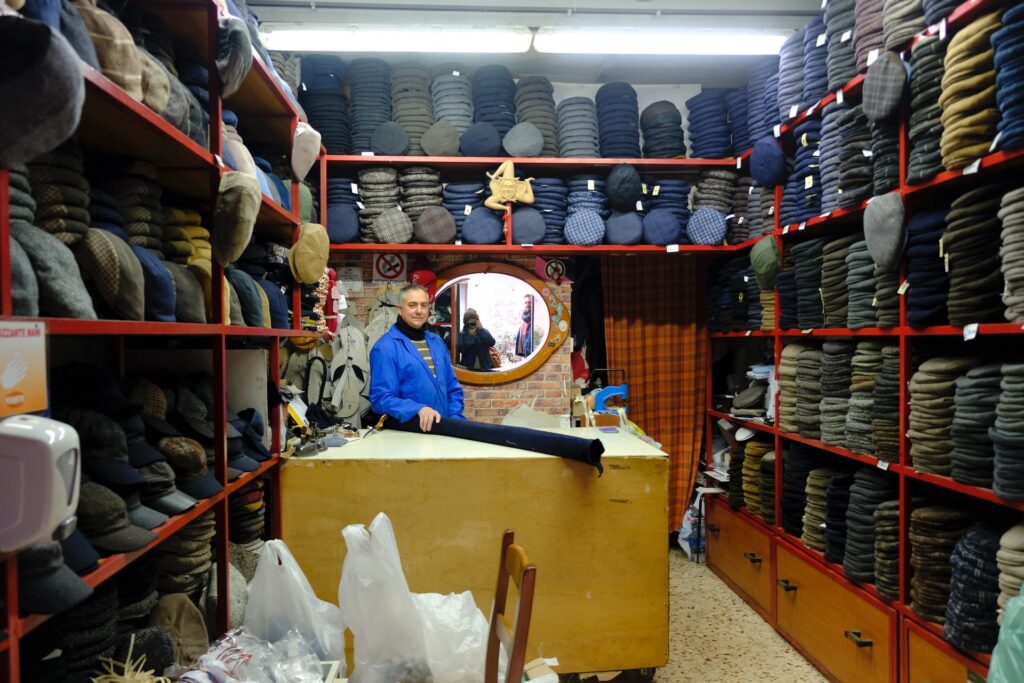
Only afterwards did I realise that I had completely forgotten to visit the Museum of Majolica Tiles (Museo delle Maioliche Stanze al Genio), despite having bookmarked an entire museum dedicated to tiles before the trip. Instead, I had wandered into a shop and bought Tunisian ones. The irony was not lost on me.
I ended the day with a late lunch after many hours of markets, churches and architecture fangirling.
Day 3: Cefalù and a Change of Pace
On my third day, the sun finally appeared. It was not particularly dramatic, but after two days of rain, I took it as a sign and boarded a morning train to Cefalù, a seaside town about an hour from Palermo.
Although Cefalù is often described as a beach destination, in winter it felt like a village in hibernation. There were no crowds of sunburnt tourists, just women doing their shopping, elderly men talking on benches and locals going about their day beside the Tyrrhenian Sea.
I started in the historic centre at Cefalù Cathedral (Duomo di Cefalù), but parts of it were boarded up for what looked like never-ending renovations, so I didn’t stay long.
The cobbled streets eventually led me to Porta Marina, a stone archway framing the sea. Through it, the water looked slate blue and silver against the quiet shoreline. I later discovered that this location appeared briefly in Indiana Jones and the Dial of Destiny, during the chase in which Teddy Kumar is kidnapped.
It felt like the last place you would expect an action sequence.
I walked down to the wharf, where a few locals sat beside the water or cast fishing lines from the edge. When I turned back towards the town, I saw the view I had been waiting for: the terracotta rooftops, cathedral towers and La Rocca rising behind them.
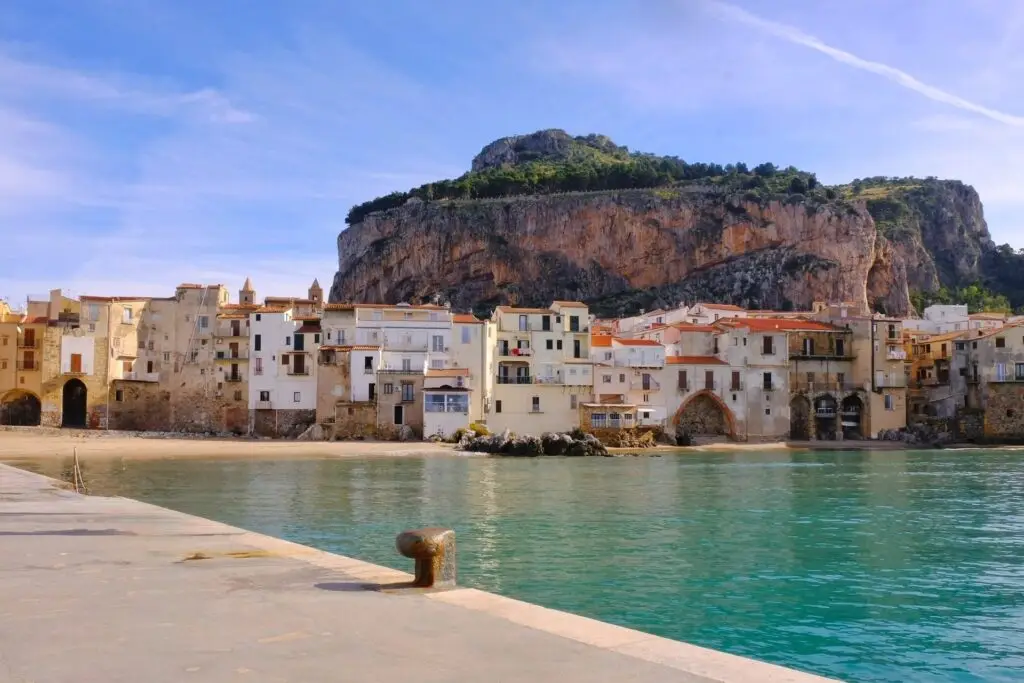
That exact view had once been the screensaver on my phone. It had become a makeshift vision board for somewhere I hoped to visit one day, and now I was standing in front of it instead of looking at it through a screen.
A scene from Cinema Paradiso also came to mind, in which the townspeople watch Ulysses outdoors until a storm interrupts the screening. That scene was filmed in Cefalù, but on this particular day there was no storm, just the sea breeze and the sound of the town around me.
At the far end of the wharf, I found a railing covered in rusty love locks. Some of the names and initials were barely legible after years of exposure to the salt air.
Naturally, my quiet moment could not last. My camera decided to act up, and the battery refused to charge no matter how many times I tried. I gave up and used my phone instead. It was not ideal, but I was not going to let a temperamental camera ruin the afternoon.
On my way back through town, I stopped at Sfrigola Cefalù for a hot arancino. The flavours may not have been traditional, but it was crispy, warm and exactly what I wanted.
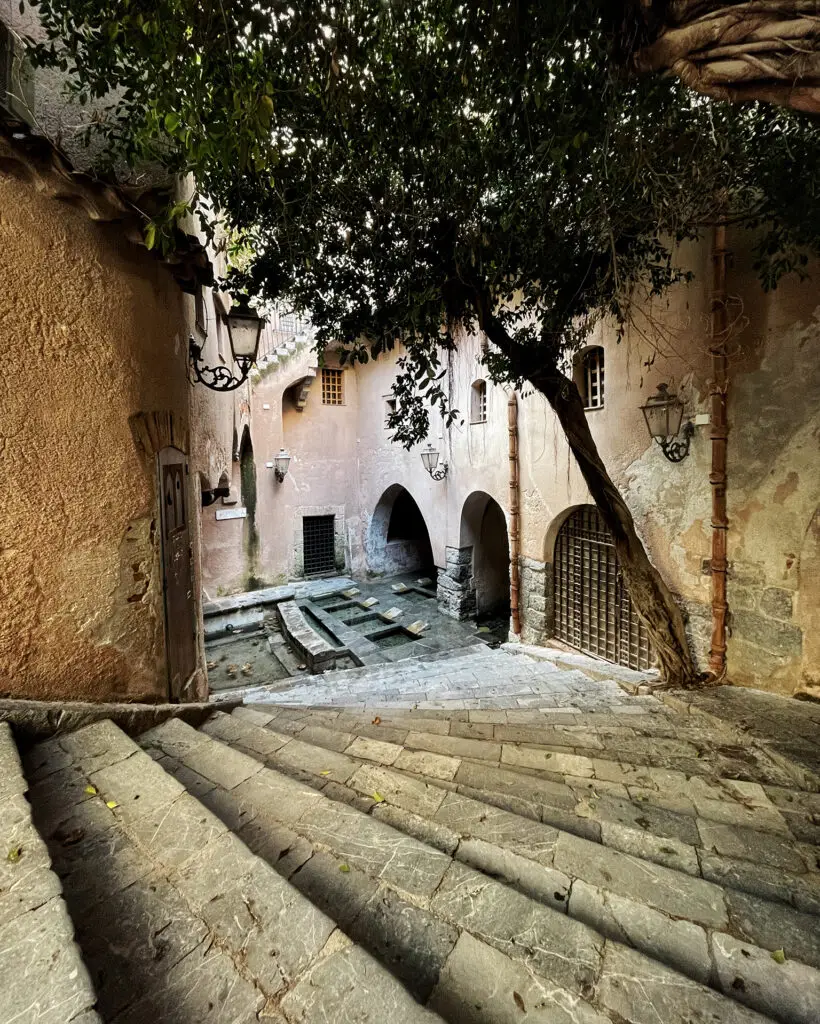
Nearby, I found the Medieval Washhouse (Lavatoio Medievale Fiume Cefalino). A narrow stone staircase leads down to the old basins where generations of women once washed clothes in running water. It is small and easy to miss, but I stayed for a while imagining how noisy and busy it must once have been.
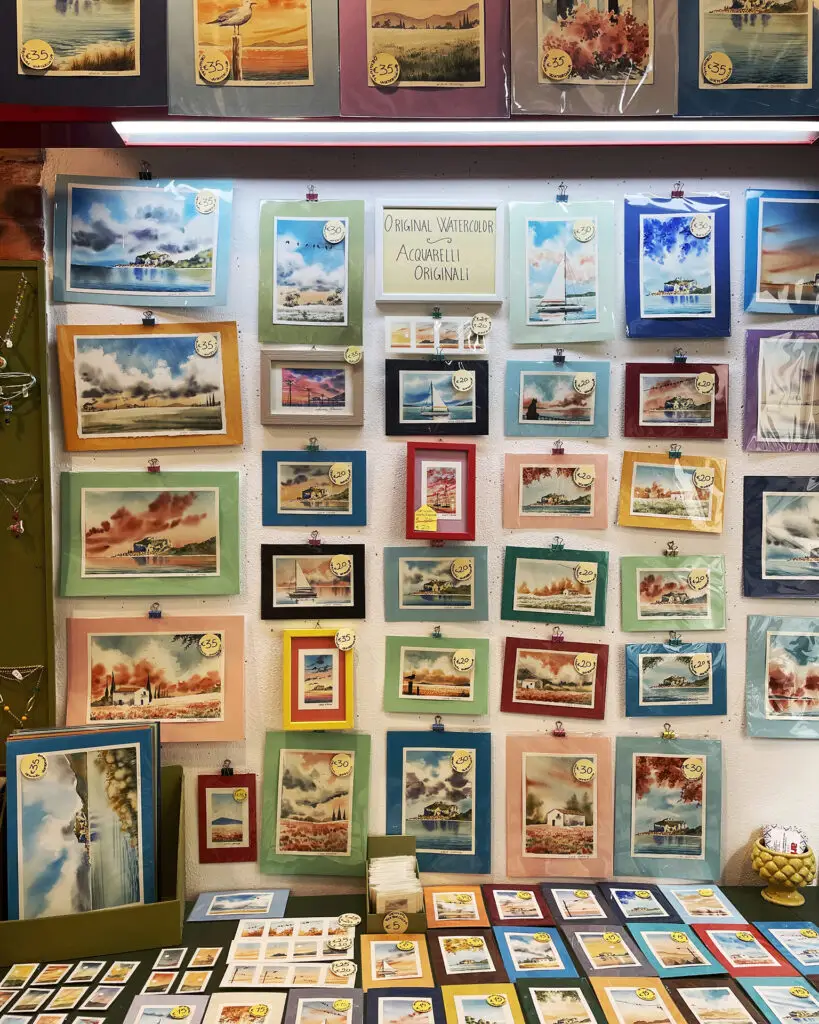
Further along, an elderly man sat weaving fishing nets by hand. A few steps away was Art Studio – SiciliaDipinta, a small art studio filled with original watercolour paintings of Cefalù’s streets and landscapes. They ranged from large, frame-ready paintings to tiny pieces that could fit in one hand. Naturally, I did not leave empty-handed. I have developed a habit of buying art from the places I visit. Nothing terribly expensive, just small reminders of where I have been. One day, I will finally frame all of them.
By early afternoon, I had completed everything on my very short list. Many of the shops had closed for siesta, so I headed back towards the station just as school finished for the day and found myself surrounded by students and backpacks.
Back in Palermo, the pace immediately felt quicker. It was still early, the sky remained clear and I was not ready to call it a day.
I went directly to the Church of Saint Mary of the Admiral (Chiesa di Santa Maria dell’Ammiraglio), but it was closed. Beside it was the Church of Saint Cataldo (Chiesa di San Cataldo), a smaller and more austere building topped by three red domes. Its geometric floors and simple stone interior felt more Arab-Norman than Catholic.
It was beautiful in a very restrained way,but I still wanted something more layered to end the day.
Luckily, just around the corner was the Church and Monastery of Saint Catherine of Alexandria (Chiesa e Monastero di Santa Caterina d’Alessandria). I hadn’t known exactly what to expect, but it ended up being one of the most extraordinary places of the trip.
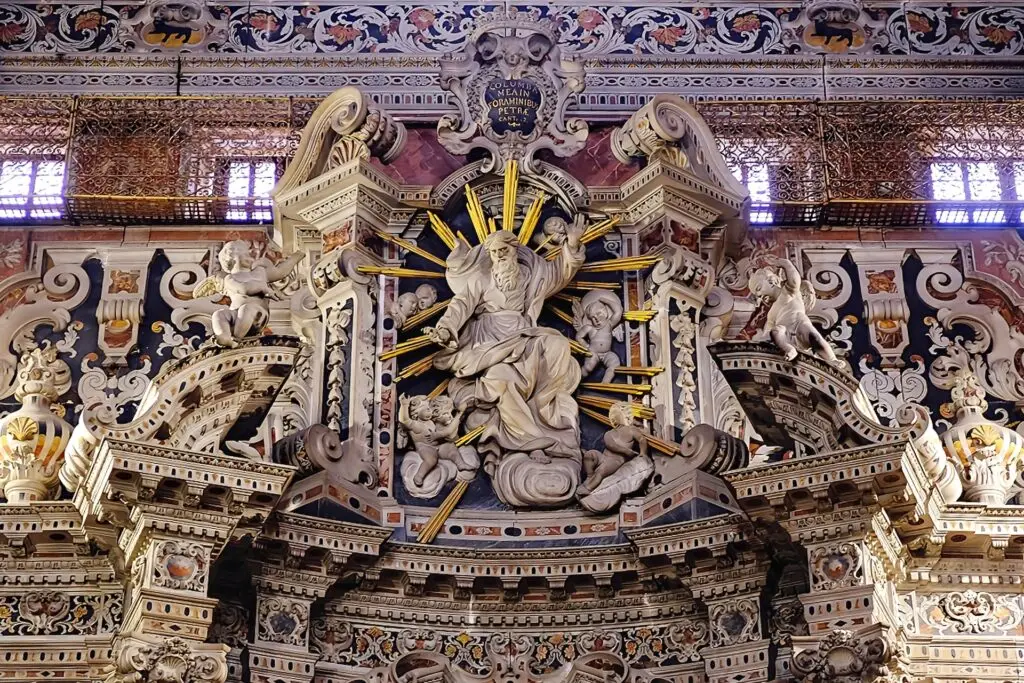
You enter the church first, and it’s the Baroque of all Baroques. From the outside, you’d never guess what was waiting inside. The moment I stepped through the doors, I froze. The sheer scale, the drama, the detail. Every blinking inch was doing the most. A single soaring nave was wrapped in layers of marble and gold, with columns, cornices and flourishes that curled, climbed and glittered in the light. Statues lined the walls as though they’d been caught mid-monologue. Light streamed through the high windows and landed on surfaces so ornately layered that I wasn’t sure where to look first.
I kept turning in circles because every time I thought I’d taken it all in, I noticed something else above me or behind me. It was everything, everywhere, all at once. It was excessive, almost ridiculous, and I loved it.
After the maximalist overload of the church, I followed the signs into the courtyard and former monastery. I walked through the hushed corridors and into the rooms where the nuns once slept. The rooms were tiny, each with a bed, a cross, a shelf and a small window. After everything I’d just seen inside the church, I couldn’t believe how simply they’d lived.
Then I climbed the winding staircase to the rooftop.
And suddenly…Palermo. In every direction. Warm rooftops, sunlit domes, and directly below was Fontana Pretoria, with its nude marble figures arranged around the large circular fountain. From above, I could see the whole piazza and the city stretching beyond it.
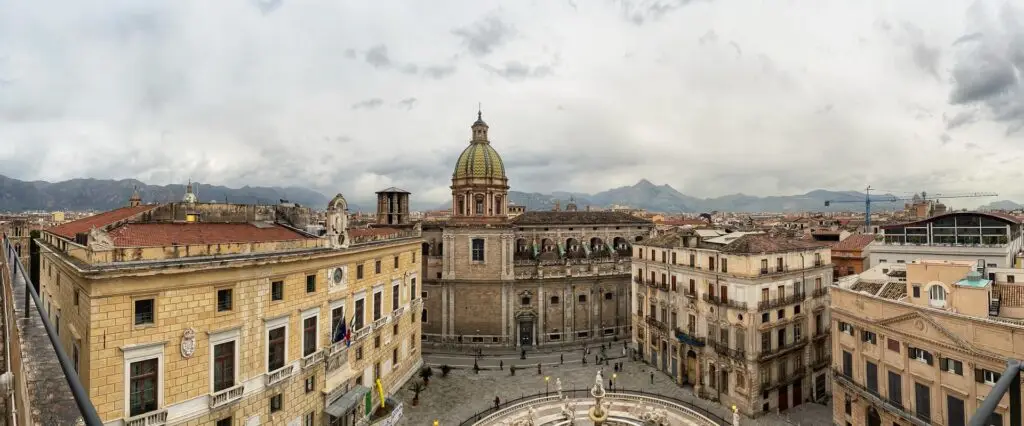
Best of all, I had the rooftop entirely to myself.
I reached for my camera, more out of habit than hope…and to my surprise, it powered on. It had refused to work throughout my day in Cefalù, but now it was behaving as though nothing had happened. I moved carefully between my camera and phone, afraid that it might suddenly stop working again.
And then it happened.
A murmuration of starlings appeared. I’d seen one in Rome the week before, but this flock was much closer. Thousands of birds twisted and turned together above the rooftops, constantly changing shape.
I filmed them with my phone, my heart somewhere near my throat. The whoosh of wings. The shapes shifting, collapsing and rebuilding in mid-air. They came so close that I could hear their wings and feel the air move as they passed overhead. I was completely consumed by it. I couldn’t believe I was standing up there alone while it was happening.
Eventually, the birds moved towards the horizon. The rain started again just as two other visitors arrived on the rooftop. I felt incredibly lucky. If I’d climbed up a few minutes earlier or later, I might’ve missed the whole thing.
I walked back down with a full heart, quietly counting my blessings. It’d been a while since I’d felt something like that. Like magic still existed.
Day 4: Rain, Paper Finds and My Last Day in Palermo
My last day in Palermo began in the rain. By then, I didn’t have anywhere I urgently needed to visit or anything major left to tick off. I just had a few errands and places I wanted to check out before leaving.
Before heading out, I asked my Airbnb host about a lovely piece of art she had framed on the wall. She told me it came from a small shop a few streets behind the apartment, so off I went, umbrella in hand.
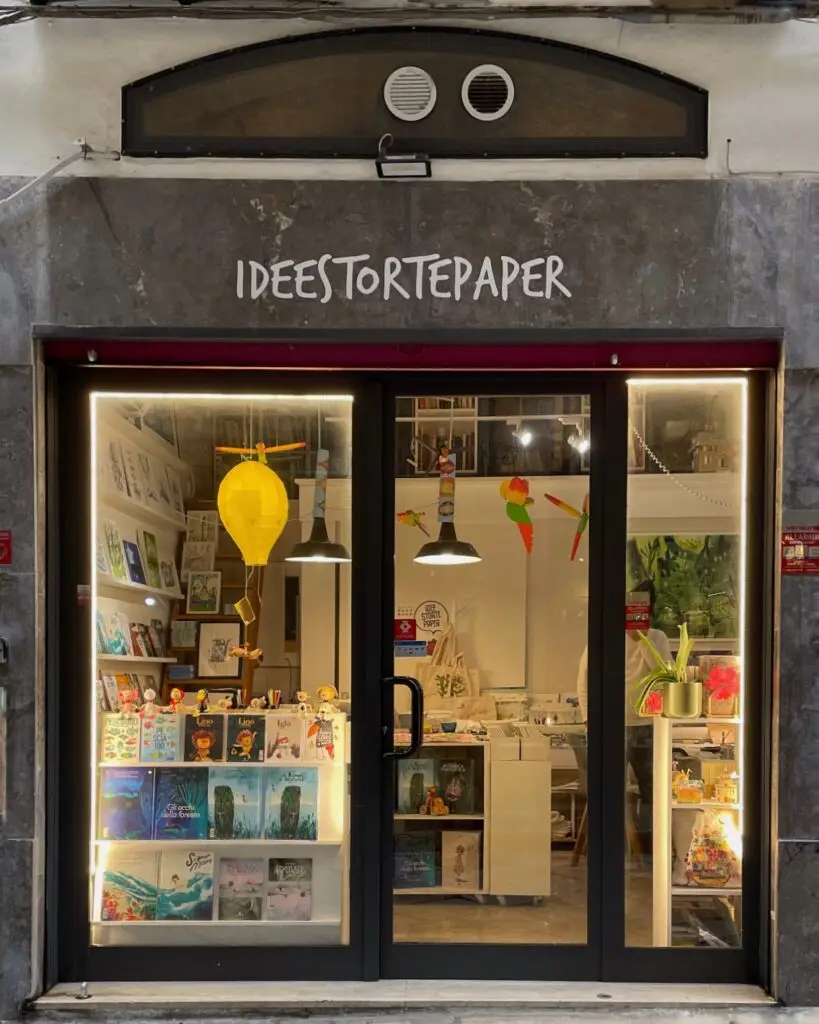
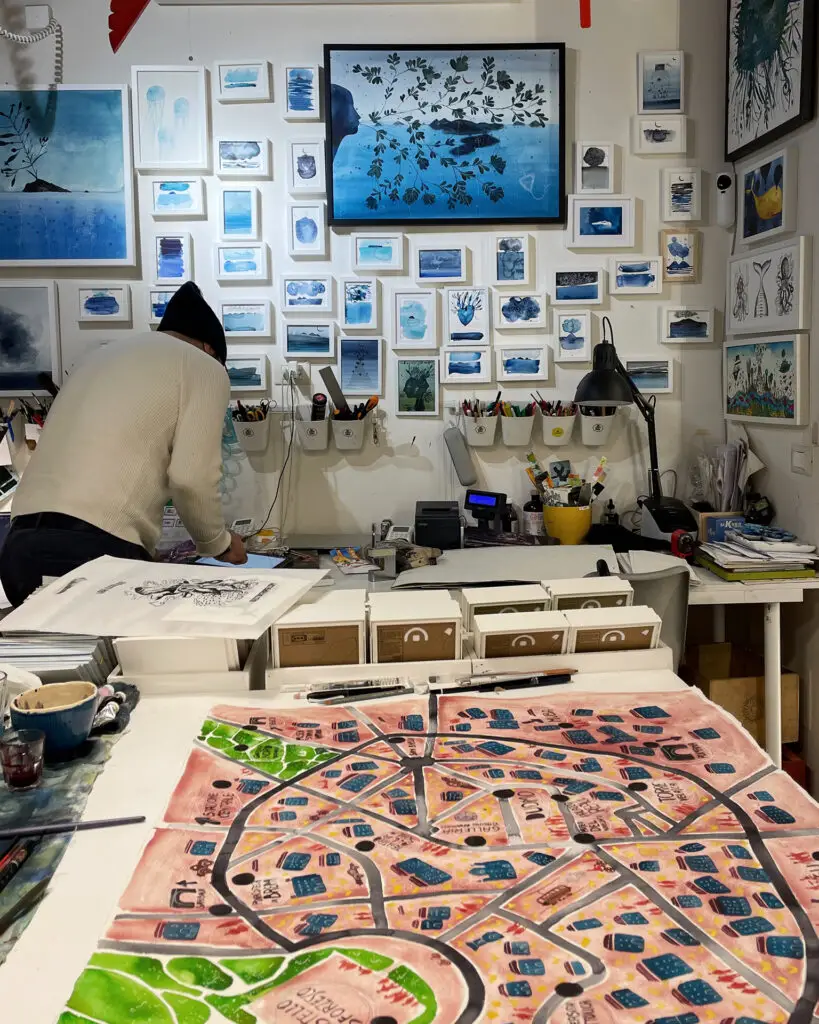
The place was called ideestortepaper, a small bookshop and creative studio tucked along a side street. The owner explained that each whimsical illustration had originally been created for the children’s books they publish. Some had been turned into postcards, prints, and zines. The shop was filled with all sorts of interesting paper things, and naturally, I left with a small stash of souvenirs I had no space for but couldn’t leave behind.
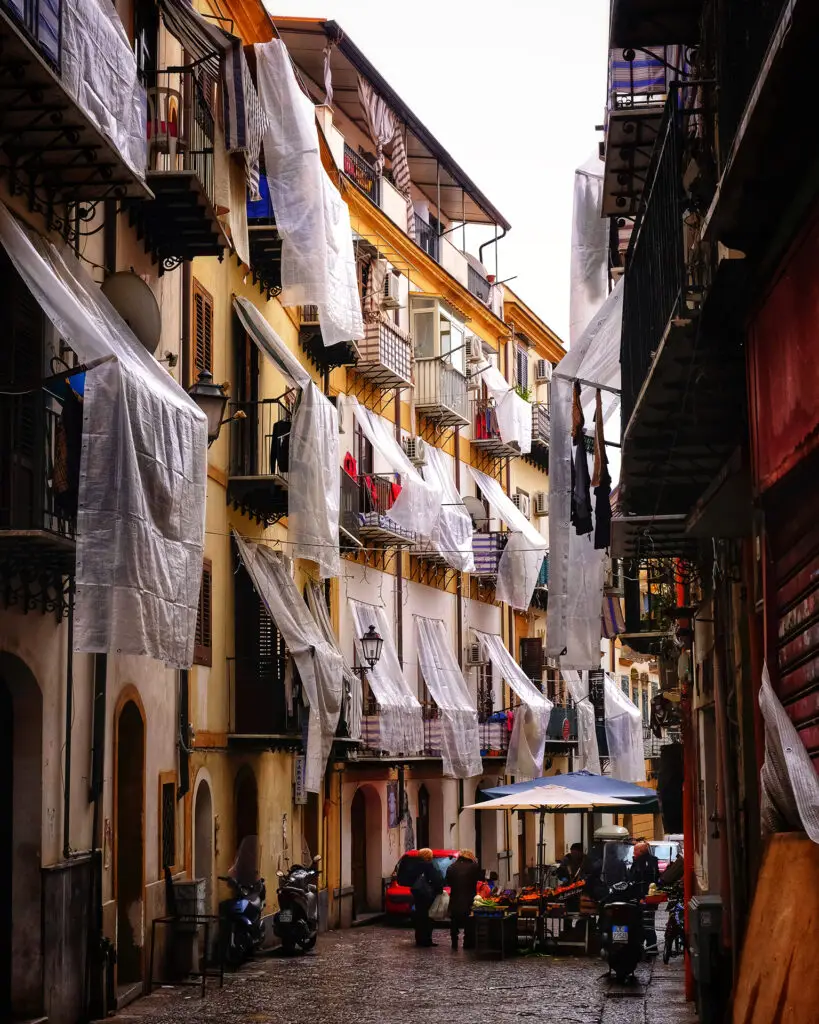
From there, I made my way to Capo Market while trying to avoid puddles and water being sprayed up by passing scooters. Compared with Ballarò, the market was smaller and slightly tidier, but still busy. I bought some pasta spices to take home, and by then my coat was damp again.
I was also undeniably churched out, but I still went into one last church.The Church of the Immaculate Conception (Chiesa dell’Immacolata Concezione) is tucked right inside Capo Market and was much more elaborate than I’d expected, with decorated chapels and gilded details. I stayed long enough to have a look around before heading back into the rain.
As I walked towards Teatro Massimo, I realised I was on the verge of being fungry. I’d bookmarked Basile Focacceria del Massimo, said to be popular with locals, and it delivered. A handwritten menu on the wall, order first, then bring the receipt to the counter. A hot plate of pasta and a can of Coke cost me just €5.50. It was exactly what I needed.
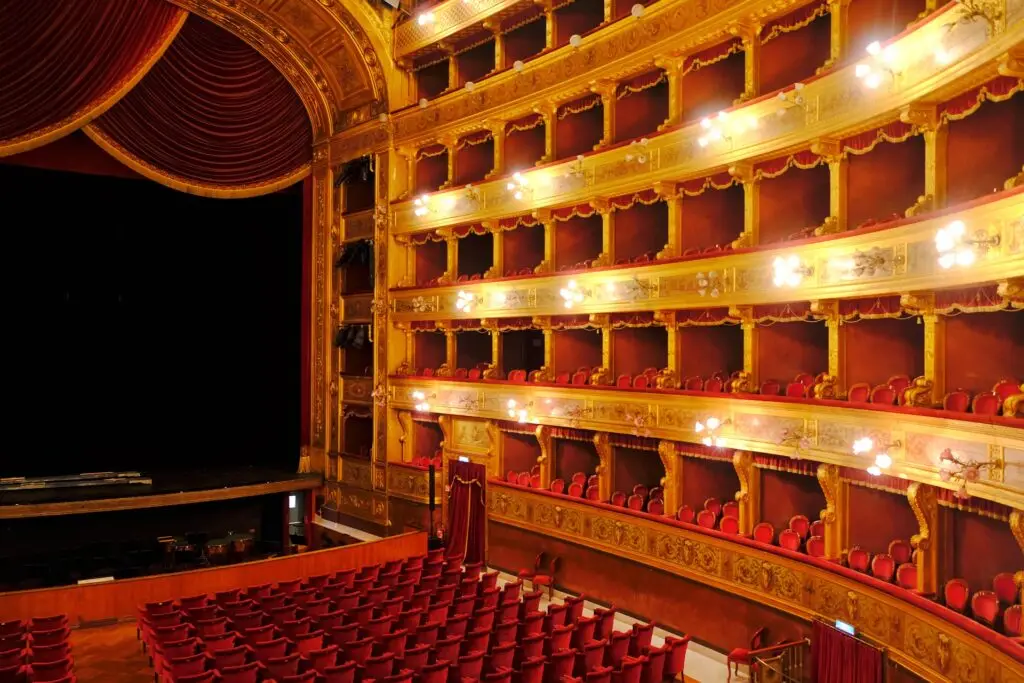
After lunch, I joined a guided tour of Teatro Massimo. The opera house was grand, with red velvet seats, golden balconies and soaring ceilings. As the guide pointed out the areas used in The Godfather Part III, I found myself mentally rewinding the film and trying to place the exact scenes. While we were walking through one of the side corridors, I heard voices echoing from somewhere else in the building. A choir was rehearsing. I couldn’t see them, but their voices carried through the corridors, and I stopped to listen for a while.
My final cultural stop was the No Mafia Memorial (No Mafia Memoriale), a museum about Sicily’s anti-Mafia movement. Through photographs, documents and personal accounts, it tells the stories of the judges, journalists, activists and ordinary people who stood up against the Mafia, sometimes at the cost of their lives. It was sobering and gave me a better understanding of a part of Sicily’s history that goes far beyond the films and popular culture most of us know.
I spent the rest of the afternoon doing some last-minute souvenir shopping and regretting that I hadn’t packed lighter. I grabbed a pizza to go from Biga (because what’s one more carb at this point?) and returned to my apartment to face the inevitable: packing and mentally preparing for the next morning’s transit adventure.
I’d missed the deadline to reserve a shared taxi from Palermo Centrale to the airport, which had to be booked at least 24 hours in advance. Thankfully, taking the train was straightforward. It ran directly to the airport and dropped me beneath the terminal, which was easy, efficient and exactly what my travel-anxious brain needed.
A Rainbow Farewell
I wrote this in my phone notes shortly after the plane took off from Palermo:
I sat there, phone to the window, filming one last glimpse of the city as the plane climbed. Low clouds hung over Mount Pellegrino, towering above the rooftops like a quiet guardian. I kept filming, even as the view began to blur, until something appeared through the mist.
A rainbow.
I hadn’t seen a rainbow in more than a year. And I often wondered why? Why I wasn’t lucky, why those moments of quiet beauty seemed to escape me. In the past, whenever I did catch one, it brought a flicker of joy. A reminder that maybe I was okay. Maybe things were okay.
This trip, I saw five. Maybe more.
And that final faint arch of colors was the last, like bidding arrivederci, see you again. I guess when they say there’s a pot of gold at the end of the rainbow, for me that pot of gold was Sicily.
Written 12 Jan, on the flight.
Plan your own itinerary
Visit
- Teatro Massimo (Massimo Theatre): Italy’s largest opera house, with red velvet seats, gilded balconies and guided tours. You may even hear a rehearsal taking place.
- Mercato di Ballarò (Ballarò Market): A busy street market filled with produce, arancine and vendors cooking over charcoal.
- Mercato del Capo (Capo Market): Smaller and slightly tidier than Ballarò, with an elaborate Baroque church hidden among its stalls.
- Chiesa del Gesù, or Casa Professa (Church of Jesus): An extravagant Baroque church covered in coloured marble, carvings and gold.
- Chiesa del Santissimo Salvatore (Church of the Most Holy Saviour): An unusually shaped Baroque church that once formed part of a larger monastery.
- Cattedrale di Palermo (Palermo Cathedral): A mixture of Arab, Norman, Gothic and Baroque architecture. Rooftop tickets are available for views across the city.
- Palazzo dei Normanni (Norman Palace): A former royal palace known for its architecture and the Palatine Chapel within it.
- Cappella Palatina (Palatine Chapel): The highlight of the Norman Palace for me, covered in Byzantine mosaics and topped by an intricately carved wooden ceiling.
- Chiesa di San Giovanni degli Eremiti (Church of St John of the Hermits): Known for its red domes, Arab-Norman architecture and courtyard filled with orange trees.
- Chiesa di Santa Maria dell’Ammiraglio, or La Martorana (Church of St Mary of the Admiral): A historic church known for its Byzantine mosaics. Unfortunately, it was closed when I visited.
- Chiesa di San Cataldo (Church of St Cataldo): A small, austere church with geometric floors and three distinctive red domes.
- Chiesa e Monastero di Santa Caterina d’Alessandria (Church and Monastery of Saint Catherine of Alexandria): An ornate Baroque church, former monastery and rooftop overlooking Piazza Pretoria.
- Chiesa dell’Immacolata Concezione al Capo (Church of the Immaculate Conception at Capo): An unexpectedly elaborate Baroque church tucked inside Capo Market.
- Chiesa di San Giuseppe dei Teatini (Church of Saint Joseph of the Theatines): A large Baroque church with a tiled dome near Quattro Canti. I missed it during this trip.
- No Mafia Memoriale (No Mafia Memorial): A museum documenting Sicily’s anti-Mafia movement and the people who opposed organised crime.
- Quattro Canti (Four Corners): A Baroque square where the four façades represent the seasons, Spanish kings and Palermo’s patron saints.
- Catacombe dei Cappuccini (Capuchin Catacombs): A macabre historic site containing preserved bodies and mummies. I didn’t visit it during this trip.
- Orto Botanico di Palermo (Palermo Botanical Garden): Palermo’s historic botanical garden, with tropical plants and palm-lined paths.
- Cefalù: An easy day trip from Palermo for coastal walks, historic streets and views of the town beneath La Rocca.
- Duomo di Cefalù (Cefalù Cathedral): The town’s Norman cathedral, known for its fortress-like towers and Byzantine mosaics.
- Porta Marina (Marine Gate): A stone arch framing the sea in Cefalù, which also appeared in Indiana Jones and the Dial of Destiny.
- Duomo di Monreale (Monreale Cathedral): Located outside Palermo and famous for its mosaics and views. I missed it, which gives me another reason to return.
Eat
- Basile Focacceria del Massimo – A no-fuss local spot just by the theatre. Handwritten menu, pay-first system, pasta for €5.50. Unpretentious and satisfying.
- Biga – My go-to. I didn’t do big meals in Palermo, but I always grabbed a slice or two from Biga, reliable, comforting, and always hit the spot.
- Assud a Santamarina Pizzeria Siciliana – Traditional Sicilian pizzeria serving wood-fired pizzas and regional specialties in a casual setting.
- Basile Focacceria del Massimo – A no-frills local eatery known for affordable pasta, focaccia, and quick Sicilian comfort food near Teatro Massimo.
- Sfrigola Cefalù – Grab a non-traditional arancino and wander with it. Comfort food in crispy form.
Shop
- Capo Market & Ballarò Market – Great for food souvenirs like dried pasta spices and herb blends.
- ideestortepaper – A tiny publishing house/bookshop filled with original art and printed ephemera. Perfect for paper lovers and quirky gift hunters.
- Art Studio – SiciliaDipinta (Cefalù) – Father-daughter watercolor works of local landscapes. Small pieces you can tuck in your palm or suitcase. Location map
- Mascari Francesco – Shop known for coppola hats. Fair prices. I got one for my dad here. Location map.
Stay
- Airbnb in La Kalsa – Top-floor room in a private apartment, great for solo travellers and close to all the main sights. Lovely terrace, friendly dog, and a heads-up: the final flight of stairs is very steep and has no handrail.
There will be a more suggestive list in my Palermo guide. – Coming soon!
Getting There / Getting Around
- Getting in by Plane – Palermo is served by Falcone Borsellino Airport (PMO), located about 35 km from the city. From the airport, you can take a direct train to Palermo Centrale—it runs frequently and takes about 1 hour. Train fare is approximately €6.80.
- Airport Transfer – Autoradio Taxi offers a shared taxi service between Palermo Centrale and the airport (and vice versa). Best to book at least 24 hours in advance. €10 per passenger (min 4 passengers). A private taxi costs around €50. To book, WhatsApp: +39 331 328 4403
- From Ortigia to Palermo – You can reach Palermo by bus or train. (Here’s my Ortigia post if you’re planning a combo trip.)
- From Catania to Palermo – Direct intercity buses and trains connect the two cities. The train ride takes around 3 hours, and the bus is slightly quicker. Buses are often the more comfortable option.
- Day Trip to Cefalù – Trains run regularly and take about 1 hour. Very doable in half a day.
- Public Transport – Walk when you can. Most attractions are central. Buses and regional trains are frequent but not always punctual.
- Train Tips – Use the Trenitalia app (or Trenit, which is also great for schedule comparisons) to book train tickets or check timings. If you’re taking a regional train, always validate your ticket before boarding using the small green machines at the station.
Keep Exploring Sicily
If you enjoyed this story, you might also like:
- Taormina in Winter: A Solo Traveler’s Peaceful Escape
- New Year in Catania – My Winter Trip to Sicily’s Black City
- Why I Fell in Love with Ortigia, Sicily – A Solo Travel Guide & Story
- Winter in Palermo – A Travel Story of Rain and Resilience
Along the way, I squeezed in unforgettable side trips to places like Savoca, Mount Etna, Cefalù, and the Valley of the Temples. Each one added a different color to the Sicilian palette.